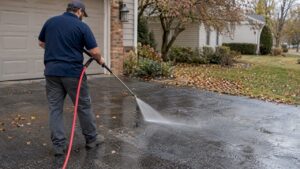
Most grease stains can be removed from concrete, but success depends on how quickly one acts and how deep the grease has soaked into the porous material. Fresh spills are typically treated with an absorbent, a degreaser, and a stiff brush, while older, set-in stains usually require a poultice to draw the grease out of the pores. Concrete's porous nature allows grease to wick in and deepen over time, which is why older stains are more challenging to remove. For stubborn stains that resist home remedies, American Bin Cleaning provides residential pressure washing across Chicagoland, utilizing an on-board recycling system to capture wastewater.
You can remove most grease stains from concrete, but how well depends on two things: how fast you act and how deep the grease has soaked in. A fresh spill comes out with an absorbent, a degreaser and a stiff brush. An old stain usually needs a poultice, which is a paste that pulls grease back out of the pores, and sometimes two or three rounds. This guide walks through both, explains why the usual kitchen-sink advice can backfire, and tells you when a pressure washing crew is the cheaper fix.
What are the key steps to remove grease stains from concrete?
- Blot or absorb loose grease first, before any cleaner touches the slab.
- Fresh stains: degreasing cleaner, 30 minutes of soak time, a stiff nylon brush and hot water.
- Old stains: a poultice of absorbent powder and cleaner, left to dry, then scraped off. Expect to repeat it.
- Skip gasoline and solvents, test a hidden patch first, and judge your results only after the concrete is fully dry.
- Stains that survive two rounds, or cover a big driveway, are a job for professional hot-water pressure washing.
Table of Contents
- Why grease sticks to concrete
- Step 1: Take up the free grease first
- Step 2: Clean a fresh stain
- Step 3: Treat an old, set-in stain with a poultice
- What not to use
- Special case: concrete pavers
- Concrete near trash bins
- Our perspective: what actually works
- When to call a professional
- Keep it clean: our service
- Preventing the next stain
- FAQ
- Sources
Why grease sticks to concrete
Concrete looks solid, but it is full of tiny pores. When grease or oil lands on it, the liquid wicks into those pores and keeps moving down for as long as it stays liquid. That is why a spill you wipe up within minutes leaves almost nothing, while a drip that sits through a Chicagoland summer leaves a dark patch that scrubbing alone barely touches.
Three things decide how hard a stain will be:
- Age. The longer it sits, the deeper it goes.
- Surface finish. Sealed concrete resists staining. Bare, broom-finished driveway concrete soaks everything up.
- Type of grease. Cooking grease from a grill or a dropped bin bag, motor oil, and transmission fluid all behave a little differently, but the removal logic is the same: lift out what is liquid, dissolve what is left, draw out what has sunk in.
It also helps to know that stains do not reliably fade by themselves. Weather and foot traffic may lighten the top layer, but oil that has soaked in tends to stay in the slab and darken the spot again when it gets wet. Treat the stain rather than waiting for it to go.
Step 1: Take up the free grease first
Whatever you do next, start here. Wipe or absorb as much loose grease as you can and collect it for disposal, as this stain removal guide also advises. Cleaner applied over a puddle only spreads the problem.
For a fresh spill:
- Blot with paper towels or rags. Press, do not rub, so you do not push grease sideways into clean concrete.
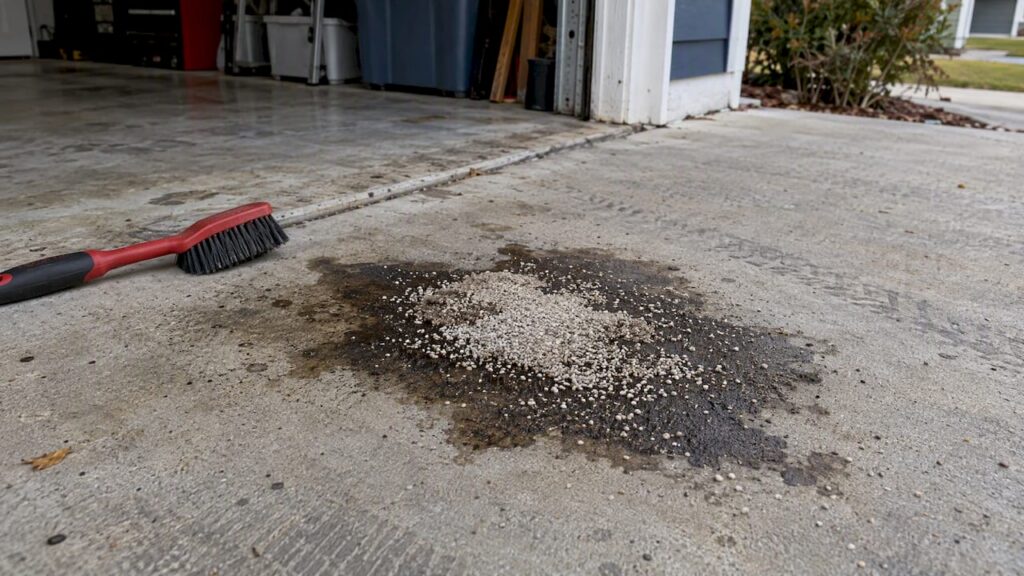
- Cover what remains with cat litter, sawdust or cornstarch, grind it in with your shoe, and leave it for several hours or overnight. Sweep it up and dispose of it with household waste, following your local rules for oily materials.
If your garage floor has an epoxy or polyaspartic coating rather than bare concrete, the rules change, because harsh cleaners can dull a coating. A guide to removing marks without damaging epoxy covers that case. The rest of this article is about uncoated concrete.
Step 2: Clean a fresh stain
For a stain from the past few days or weeks, this is the routine that Today’s Homeowner lays out in its grease-stain guide: apply dish soap, laundry detergent or a degreasing cleaner, let it soak for 30 minutes, scrub with a stiff nylon brush and hot water, rinse thoroughly, and repeat if the stain is still visible.
A few practical notes from doing this on real driveways:
- Use a nylon brush, not wire. Steel bristles leave shiny scratches and rust flecks on the surface.
- Hot water matters. It thins the grease so the cleaner can reach it. A kettle or a bucket from the utility sink works for a small spot.
- Mind the sun. Do not put degreaser on concrete in direct, hot sunlight. The same guide notes that the cleaner can dry before it does any work. Choose a shaded, cooler part of the day.
- Work downhill-aware. For sloped pavement, a technical bulletin from a paver industry group recommends starting at the bottom and working up in manageable sections so that cleaning fluid drains over areas you have not yet done, rather than streaking clean ones.
Will Dawn work on concrete?
It is the question everyone asks, and the answer is: sometimes, with a caveat. Dish detergent does cut food grease. The paver industry bulletin above suggests applying liquid detergent at full strength to stubborn food-grease stains, letting it penetrate for 20 to 30 minutes, then scrubbing and rinsing with hot water.
The caveat is that General Services Administration guidance, reproduced by InspectApedia, advises against ordinary soap on concrete because it can react with lime in the concrete and form a scum, which may make the surface soil faster. In practice: a quick dish detergent pass on a fresh spot is reasonable if you rinse very thoroughly, but a purpose-made degreaser is the safer first choice, and detergent is not the tool for an old stain.
Step 3: Treat an old, set-in stain with a poultice
When grease has been in the slab for months or years, scrubbing only cleans the surface. You need something that pulls the grease up out of the pores. That is what a poultice does.
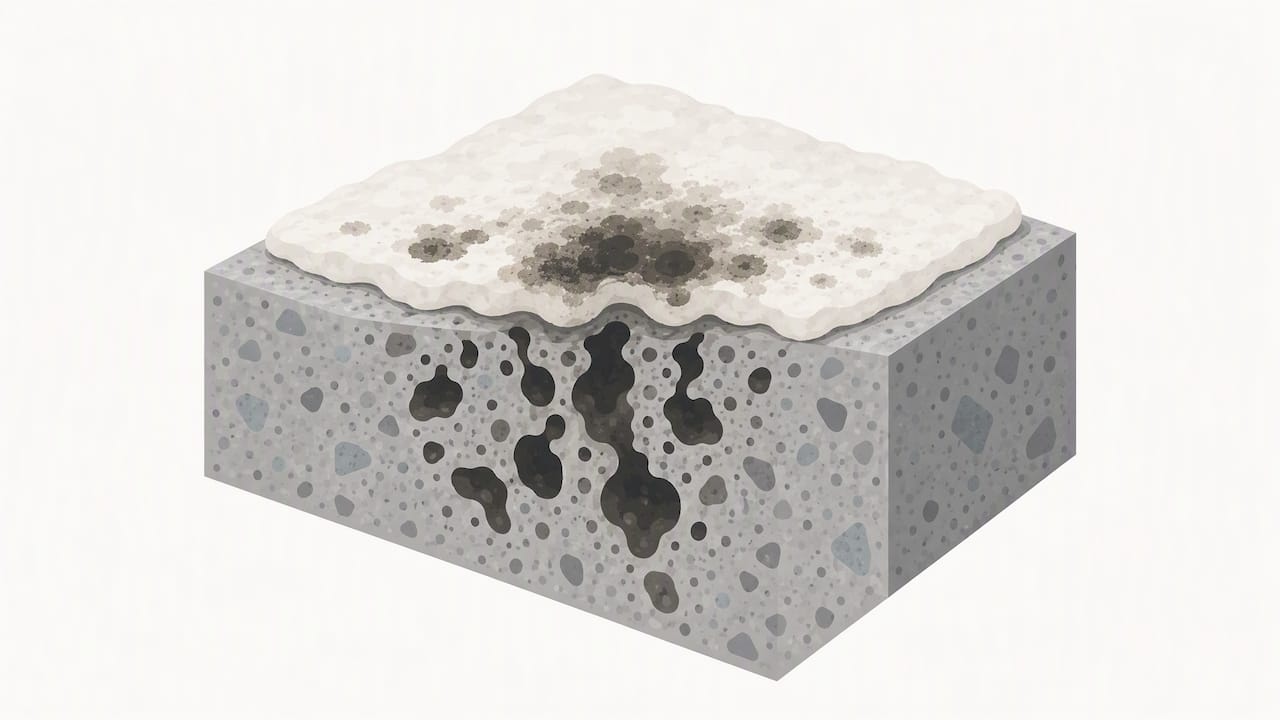
The GSA method, again via InspectApedia, mixes whiting with trisodium phosphate into a thick paste. You spread it in a layer roughly 1/8 to 1/4 inch thick, let it dry, then scrape it off and rinse the surface. Trisodium phosphate is a harsh chemical, so read the label, wear gloves and goggles, and keep it off lawns and beds.
A simpler home version uses the same logic: an absorbent powder such as cat litter ground fine, diatomaceous earth or baking soda, mixed with a degreaser to the texture of peanut butter.
- Clean the spot and let it dry.
- Spread the paste over the stain and about an inch past its edges.
- Cover with plastic taped at the edges if the product directions say to, and let it sit until it is fully dry, often overnight.
- Scrape it off with a plastic scraper, sweep, and rinse.
- Repeat. A deep stain commonly needs more than one application, and each round usually lightens it further.
Judge the result when it is dry
Wet concrete is darker, and a damp patch can hide a stain that is still there or make a clean spot look dirty. ConcreteCalculate points out that you should only evaluate the result once the slab has completely dried. Give it a full day of dry weather before you decide to go another round.
What should you avoid using to clean grease stains from concrete?
| Method | Why to avoid it |
|---|---|
| Gasoline, mineral spirits, other volatile solvents | The GSA cautions that these can drive oil deeper into the concrete rather than lift it, and they are a fire hazard (see InspectApedia) |
| Wire brush | Scratches the surface and leaves a permanent mark worse than the stain |
| Bleach | Does nothing for oil and can discolor the slab and kill nearby plants |
| Pouring on cola or other kitchen folk remedies | Cheap, but unreliable on anything beyond a light fresh spot, and it leaves sugar residue |
| Unlimited acid | Etches the surface and can damage joint sand and pavers; use only products meant for your surface |
Whatever you choose, follow the product label. The same paver bulletin recommends using proprietary cleaners made for the surface where possible, testing a small hidden spot first, wearing protective clothing and goggles with acidic solutions, and keeping runoff away from vegetation.
How do you clean grease stains from concrete pavers?
Patio and walkway pavers soak up grease from grills and dropped food just like a slab, but they have joints filled with sand, and aggressive treatment can wash that sand out. Use the detergent method above for food grease, keep any pressure washing gentle, and re-sand the joints afterward if needed. Our guide on pressure washing pavers at 500 to 1,500 PSI explains how to protect joint sand.
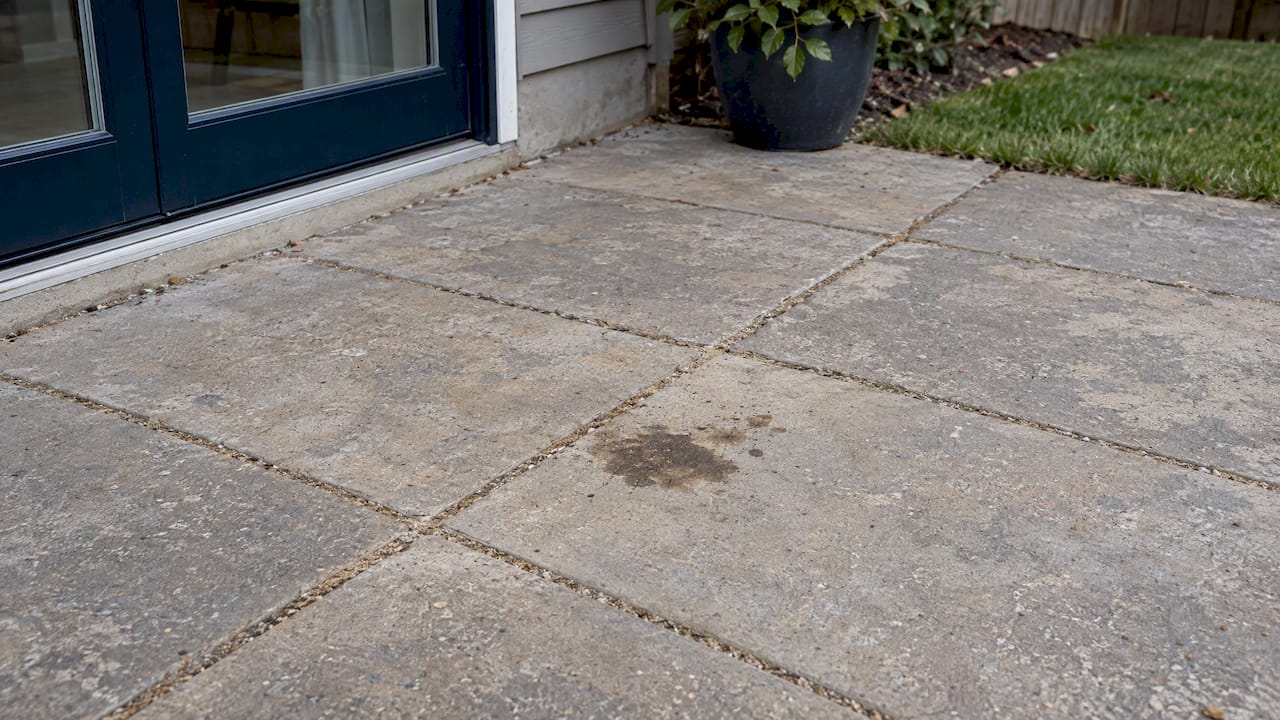
If a paver patio is stained again and again, sealing can make future cleanups much easier. This explanation of signs it is time to seal pavers helps you decide. Clean the pavers first, because sealing over grease locks it in.
Why does concrete near trash bins get grease stains, and how can they be prevented?
Grease stains often cluster in the same few places: the spot where the garbage cans sit, the curb where they get dragged, and the pad around a dumpster. Bins leak. Bags tear, liquid runs out of the bottom, and a bin full of food waste in July leaves a ring on the driveway that outlasts the smell.
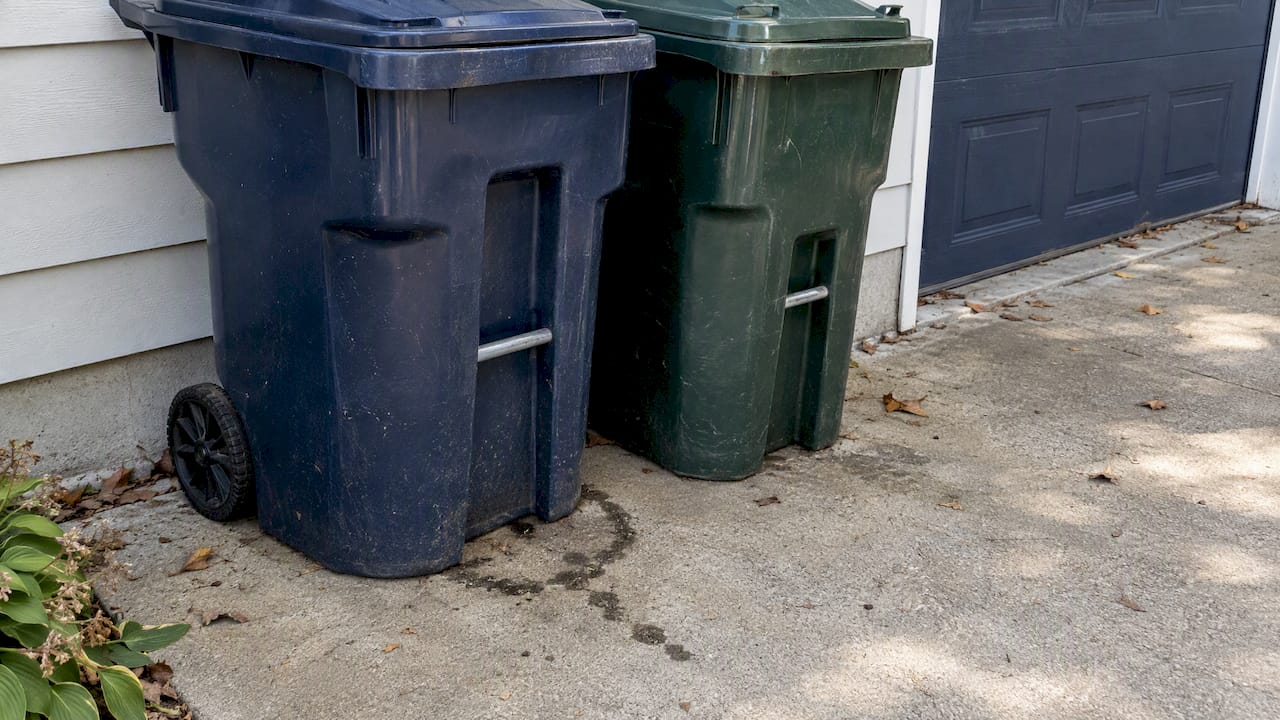
If that is your pattern, cleaning the stain and ignoring the bin means it will come back. Clean bins leak less and attract fewer pests, and a bin pad that gets rinsed regularly never builds up a stain deep enough to need a poultice. For more on what accumulates around bins, see our overview of outdoor contamination around bins, pads and driveways. Property managers dealing with the same problem at a dumpster enclosure can read about dumpster pad odor control.
What are the most effective methods for concrete grease stain removal, based on professional experience?
We have been cleaning bins and washing concrete around Chicagoland since 1989, and the same few lessons keep showing up.
First, speed beats strength. A paper towel and ten minutes the day it happens beat any chemical you will buy later. Second, most failed DIY attempts fail at the same point: people scrub a stain that has already soaked in, see a lighter surface, and stop. The grease is still in the slab, and it comes back dark after the next rain. A poultice, or hot-water pressure washing, is what gets at the part below the surface.
Third, water is part of the job. Rinsing grease and degreaser off a driveway sends it toward the storm drain and the lawn. That is why we capture our wastewater in an on-board recycling system, so nothing is dumped or runs off into the environment. If you do this yourself, put down absorbent around the area, collect what you can, and keep cleaner away from plants and drains.
Last, know your limits. Hot-water pressure washing at the wrong pressure can etch concrete or blast sand out of paver joints, and a stain that comes back after two rounds probably needs a different tool, not more elbow grease.
— Bill
When to call a professional
DIY is the right call for a small, fresh spot. A pro makes more sense when:
- The stain has been there for years and has survived a poultice or two.
- Grease covers a large area, such as a whole driveway apron, garage approach or the pad under your bins.
- You do not want cleaner runoff on your lawn, garden or a neighbor’s property.
- You are cleaning pavers and want to avoid damaging the joints.
- You are a property manager and need a documented, contained cleaning of a lot, pad or loading area. Our guide to parking lot pressure washing covers what to require.
If you are unsure what a visit involves, what driveway pressure washing involves for homeowners walks through it. We also have a guide to driveway oil stains by age, and if the discoloration you see is orange rather than dark, it may be rust, which has its own light rust fix for concrete.
How can Fresh Bins' services help keep your concrete and trash bins clean?
We handle both halves of the problem. Our residential pressure washing takes care of driveways, walkways and patios, and our eco-friendly, high-pressure trash bin cleaning keeps the bins that cause the stains clean and sanitized. You do not need to be home. Plans are $35 per 4 weeks for monthly service, $45 per quarter for quarterly service, or $75 for a one-time on-demand cleaning.
We serve homeowners across Chicagoland and into southern Wisconsin, from Barrington and Libertyville to McHenry, Lake Zurich and Lake Geneva. See the plans and book a cleaning when you are ready.
Preventing the next stain
- Put a drip pan or a flattened cardboard box under a car that leaks, and fix the leak.
- Set grills on a mat or a paver slab you do not mind cleaning, not on the driveway.
- Place bins on a rinsed, clean spot and keep lids closed. Cleaning bins on a schedule keeps leaks and residue from building up.
- Keep cat litter in the garage. It is the cheapest spill kit there is.
- Consider a concrete sealer. A sealed surface stays cleaner because spills sit on top longer, which gives you time to wipe them up.
FAQ
Can old grease stains be removed?
Often, but not always completely. Old stains have soaked deep, so a surface scrub will not do it. A poultice left to dry on the stain pulls grease upward, and a deep stain may need several applications. Some very old stains will lighten a lot without disappearing entirely.
Do grease stains eventually come out of concrete on their own?
Not reliably. Sun, rain and traffic may fade the surface, but oil that has soaked into the pores stays in the slab and often reappears when the concrete is wet. Treating the stain early is far easier than waiting.
Will Dawn remove grease stains from concrete?
It can lift fresh food grease if you let it soak for 20 to 30 minutes, scrub, and rinse with hot water. GSA guidance warns, however, that ordinary soap can react with lime in concrete and leave a scum. For anything other than a fresh spot, use a degreaser made for concrete.
Is it safe to use gasoline or solvents on a grease stain?
No. They can push oil further into the concrete, and they are flammable. Use an absorbent, a degreaser, or a poultice instead.
How long should I wait before deciding the stain is gone?
Wait until the concrete is completely dry, which in dry weather usually takes a day. Damp concrete looks darker and can make a treated spot seem stained.
Sources
- How To Get Grease Stains Out of Concrete in 6 Steps, Today’s Homeowner
- Removing Grease Stains from Concrete, GSA guidance via InspectApedia
- Tech Spec: Cleaning and Sealing, Unilock group technical bulletin
- How to Remove Oil Stains From Concrete, ConcreteCalculate