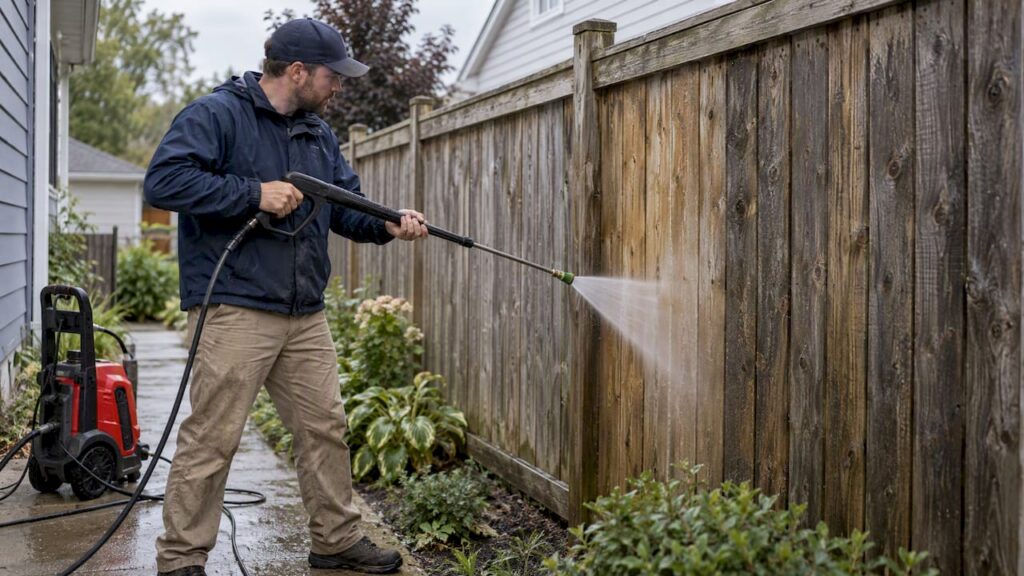
Yes, you can pressure wash a cedar fence, but cedar is a soft wood, so the way you do it matters more than the machine you own. Keep the pressure low (roughly 500 to 1,500 PSI), use a wide-fan tip, stay about 18 inches from the boards, follow the grain and test a hidden spot first. Get any of those wrong and you can leave permanent streaks, fuzzy fibers and a fence that soaks up water.
This guide covers the settings, the cleaners, the drying time before you stain, what it costs to hire the job out, and the point where handing it to a pro makes more sense.
TL;DR
- Cedar can be pressure washed, but stay at or below about 1,500 PSI, use a wide-angle tip (25 to 40 degrees) and never a 0-degree nozzle.
- Keep the nozzle at least 18 inches from the wood, work with the grain and test a hidden board before you start.
- Use a wood cleaner or a diluted bleach mix for mildew and gray weathering, rinse thoroughly, then let the fence dry for 48 hours or more before staining.
- Professional fence washing nationally averages about $0.43 to $0.53 per square foot for basic jobs, with local prices varying.
- If the boards are soft, splintered or rotting, wash by hand with a soft brush or call a professional.
Table of Contents
- Is it okay to pressure wash a cedar fence?
- What PSI is safe for cedar?
- Choosing the nozzle and distance
- Step by step: how to pressure wash a cedar fence
- Which cleaner should you use?
- How to avoid gouging and roughening cedar
- How long should cedar dry before staining?
- What does it cost to have a fence pressure washed?
- Our perspective: the fence is only as clean as the process behind it
- When to hire a professional
- Quick checklist before you start
- FAQ
- Sources
Is it okay to pressure wash a cedar fence?
It is okay, with limits. Professionals wash cedar every week, and a wood-surface guide puts the working range for wood at 500 to 1,500 PSI, lower for soft species like cedar and higher for dense ones. The damage comes from using the wrong tool, not from using water.
Cedar fibers are soft. According to Cedar Fence Direct, too much pressure can splinter the fibers, loosen fasteners, strip existing sealant and force water deep into the board. You trade a clean look this weekend for moisture and finish problems later.
Some fence restorers go further and tell homeowners to skip the pressure washer altogether. That advice makes sense for a fence that is already worn, but it is not a rule for sound boards. A fair summary:
- Sound, sealed or lightly weathered cedar: a careful, low-pressure wash is fine.
- Old, gray, fuzzy or soft cedar: hand scrubbing, or a very gentle wash, is safer.
- Rotting or splitting boards: repair or replace first. Water pressure will only make it worse.
What PSI is safe for cedar?
The figures you will see online differ a little, which is normal. Here is what the sources agree on:
| Source | Pressure | Tip | Distance |
|---|---|---|---|
| Ready Seal FAQ | No more than 1,500 PSI if possible | Widest angled tip first | At least 18 inches |
| Consumer Reports | Start low | Low-pressure, wide nozzle; avoid 0 degrees | Test an inconspicuous spot first |
| Wood-surface guide | 500 to 1,500 PSI | Wide 40-degree tip | Work parallel to the grain |
If your machine is a typical electric homeowner unit, you are probably already in range. A gas washer rated at 3,000 PSI or more is the one to be careful with. You can still use it on cedar, but only with a 40-degree tip, a longer standoff distance and a lot of caution. Many people simply back the wand away until the spray stops cutting into the wood.
Pressure is only half of it. Consumer Reports explains that a higher-degree nozzle spreads the water over a wider area, which means less force on each square inch of board. That is why a gentle machine with a pinpoint tip can do more harm than a strong machine with a broad fan.

Choosing the nozzle and distance
Pressure washer tips are color coded by spray angle. For cedar you want the wide ones:
- 25 degrees (green): the most aggressive tip you should consider, and only on solid, rough-sawn or grayed wood.
- 40 degrees (white): the safe default for smooth cedar pickets and for rinsing.
- Soap tip (black): low pressure for applying cleaner.
- 0 degrees (red): never on cedar. Consumer Reports recommends against it, and it will cut into the board.
Start with the widest tip, hold it at least 18 inches from the surface and move closer only if the dirt will not lift. Keep the wand moving. Pausing in one spot is how you get the lines and gouges that no amount of sanding fully hides.
Work with the grain, in long, even passes that overlap slightly, running the same direction as the boards. Spraying across the grain raises the fibers and leaves a rough, fuzzy surface.
If you want a second walkthrough of nozzle choice, pressure and testing on cedar, this guide to pressure washing fences safely covers the same ground with photos.
Step by step: how to pressure wash a cedar fence
1. Prepare the area
Clear plants, patio furniture and anything leaning on the fence. Cover delicate shrubs with a tarp, since cleaners and runoff can burn leaves. Tell neighbors if spray will reach their side. Sweep cobwebs and loose dirt off the boards.
Wear the right gear. Consumer Reports’ safety guidance calls for hearing protection, safety goggles, protective footwear and gloves. Never aim the wand at a person, a pet or your own feet.
2. Test a hidden spot
Pick a low board behind a shrub or near the gate. Start with the widest tip at about 18 inches, then step closer slowly. If you see the wood fibers lift, fuzz or etch, back away. That distance and tip is your working setting for the rest of the fence.
3. Wet and apply cleaner
Work in sections of a few boards at a time, so cleaner never dries on the wood. Wet the section lightly, then apply your cleaner. Simple Green’s wood fence directions suggest applying cleaner from the bottom up to avoid streaks, scrubbing stained areas with a brush and leaving it on for 3 to 5 minutes without letting it dry.
4. Rinse from the top down
Switch to a wide tip and rinse from the top of the section to the bottom, following the grain. The same directions use a 25-degree tip for the first rinse and cleaner application. For cedar, many homeowners go to the 40-degree tip right away, which is gentler.
Rinse thoroughly. Leftover cleaner can interfere with stain and leave white residue.
5. Let it dry
Only the dry wood takes stain well, so do not rush to the next step. More on that below.
Which cleaner should you use?
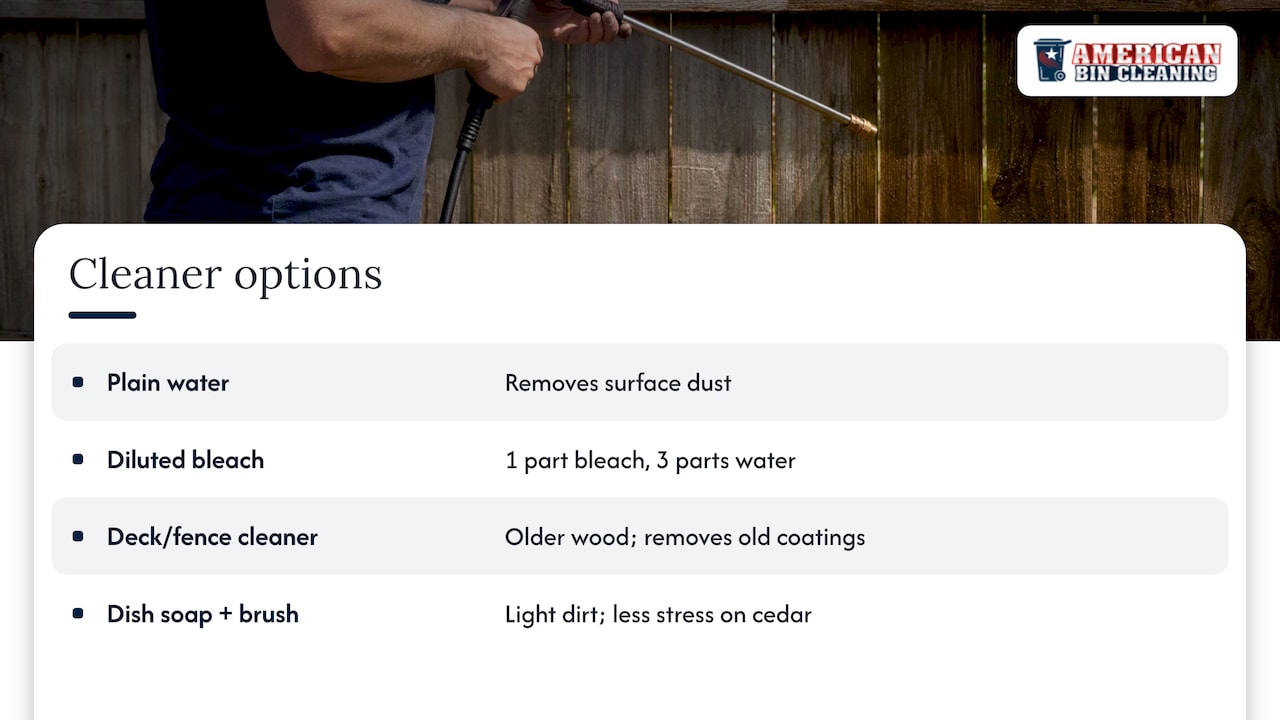
Plain water removes surface dust. For green algae, black mildew or gray weathering, you need a cleaner.
Diluted bleach. Ready Seal’s FAQ recommends a wood-cleaning mixture or chemical when pressure washing, and specifies one part bleach to three parts water for preparation. Wear gloves and eye protection, never mix bleach with ammonia or other cleaners, and wet nearby plants before and after.
Deck and fence cleaner. Ready Seal’s staining guide says older wood may need a deck-and-fence cleaner to remove dirt, algae or old coatings, while new wood should be cleaned because mill glaze can keep stain from soaking in.
Mild dish soap and a brush. For light dirt, this is often all you need. A soft brush and mild detergent can be as effective as a pressure washer on cedar and puts less stress on the wood, according to one fence maintenance guide.
Whatever you choose, the fence should end up free of mildew, dust, dirt, oil, grease and any previous stain or sealer before you recoat, per the Ready Seal FAQ above.
How to avoid gouging and roughening cedar
Most damage comes from a handful of repeat mistakes:
- Starting too close. Begin at 18 inches or more, not 6.
- Using a narrow tip. Anything under 25 degrees is a risk on cedar.
- Stopping the wand. Always keep it moving.
- Going across the grain. It raises fibers.
- Chasing every last stain. Some dark tannin staining is part of cedar. If the wood is cut before the mark lifts, stop and use a cleaner or brightener instead.
- Washing right next to joints and fasteners. Forced water at nails and screws loosens them and gets behind the board.
Also watch the fence itself. If you are blasting through a cap rail or the pickets are only loosely attached, pressure can knock things apart.
How long should cedar dry before staining?
Longer than most people expect. Ready Seal’s FAQ says to let the wood dry completely, 48 hours or more depending on weather, and its step-by-step guide recommends confirming moisture content of 12% or less before applying stain. A cheap pin-type moisture meter takes the guesswork out.
The same guide notes that stain failure usually traces back to contamination, mill glaze or applying stain when the wood is still too wet. In northern Illinois and southern Wisconsin, that means picking a stretch of dry weather, ideally in late spring or early fall, when overnight temperatures stay mild and humidity is lower. A damp week in April can easily stretch the drying time past the minimum.
Cleaning, drying, then sealing in one weekend is rare. Plan on a wash day, a dry wait, and a separate staining day.
What does it cost to have a fence pressure washed?
Homewyse’s May 2026 cost calculator estimates a national average of about $0.43 to $0.53 per square foot for basic fence power washing. Actual quotes vary with where you live, how big the fence is, how easy it is to reach and what materials are used.
To get a rough figure, measure the length and height of the fence, multiply them for square feet of one side, and multiply by the rate. A 100-foot, 6-foot-tall fence is 600 square feet per side. At the national average, that is a few hundred dollars for both sides, before extras like cleaner, staining or repairs. Ask each company whether the quote covers both sides and whether it includes prep.
Compare that to the cost of a rented washer, cleaner, safety gear and a full weekend, plus the risk of damaged boards. For a longer fence, hiring out often costs about the same as doing it right yourself.
Our perspective: the fence is only as clean as the process behind it
We have cleaned outdoor surfaces around Chicagoland since 1989, and one lesson repeats: soft surfaces punish impatience. A trash bin can take a hot, high-pressure wash. A cedar board cannot. What matters on cedar is controlling the force, and that comes from choosing the tip, the distance and the pace before you pull the trigger.
The second lesson is about water. Fence washing sends dirt, cleaner and mildew straight onto your lawn, beds and sometimes your neighbor’s yard. We capture wastewater through an on-board recycling system on our work so that nothing is dumped or runs off into the environment. If you do this yourself, keep cleaner away from plants, use the mildest product that works and rinse the area afterward. Our guide to eco-friendly pressure washing lays out the containment steps we use.
Third, do not treat cleaning as a separate event from finishing. A clean fence that is left bare grays again quickly. Plan the wash and the sealer together, and let the wood dry in between. The same logic applies to decks, and our write-up on what deck pressure washing involves and on cleaning a deck before sanding follow it too.
— Bill
When to hire a professional
Do it yourself when the fence is short, the boards are sound and you have a washer that runs under about 1,500 PSI. Hire it out when:
- the fence is long, tall or on a slope and you cannot reach it safely;
- the cedar is already gray, soft or splintering and needs a careful hand;
- you want it done and sealed in a short window;
- runoff would reach a neighbor’s yard, a pond or a storm drain;
- you have a warranty, or you are prepping for a paint or stain job you cannot afford to redo. Our page on pressure washing before painting explains when it helps.
Make sure any company you hire can tell you the pressure, tip and cleaner it will use on cedar. If they cannot answer in a sentence, keep looking.
If you are a homeowner in Lake County, McHenry County or the nearby Wisconsin lake towns, we handle residential exterior cleaning, and you can see what we offer on our residential pressure washing page. Tell us about your fence and the surrounding surfaces when you ask for a quote, so we can confirm what we can do for your property. You do not need to be home while we work. If your bins are as grimy as your fence, our recurring bin cleaning plans start at $35 per 4 weeks for monthly service or $45 per quarter, with a one-time clean at $75.
Quick checklist before you start
- Fix loose boards, nails and rot.
- Pick a dry, overcast day with mild temperatures; direct sun dries cleaner too fast.
- Protect plants and move items away.
- Suit up: goggles, ear protection, gloves, closed-toe boots.
- Set the wide tip (40 degrees to start) and test a hidden board at 18 inches.
- Apply cleaner in small sections, scrub, wait 3 to 5 minutes and rinse top to bottom.
- Dry 48 hours or more and check moisture at 12% or less.
- Stain or seal on the next dry day.
FAQ
Can you pressure wash cedar?
Yes. Use no more than about 1,500 PSI, a wide-angle tip and a standoff distance of at least 18 inches, and always test a hidden board first. Go with the grain and keep the wand moving. If the wood fuzzes or etches, back off.
What is the best way to clean a cedar fence?
For light dirt, a soft brush, mild detergent and a low-pressure rinse is gentle and effective. For mildew, algae or gray weathering, use a wood cleaner or a one-to-three bleach and water mix, then rinse well. Let the fence dry fully before sealing.
How much does it cost to have a fence power washed?
Homewyse’s national average for basic fence power washing is $0.43 to $0.53 per square foot, as of its May 2026 estimate. Your price depends on fence size, access and location, so get a written quote that says whether both sides are included.
How long should I wait to stain after washing?
Wait at least 48 hours, longer in damp weather, and aim for 12% moisture content or less. Staining too early traps water in the wood and is a common cause of peeling and blotchy finish.
Sources
- FAQs, Ready Seal
- Step By Step: How to Properly Stain a Fence, Ready Seal
- Can You Pressure-Wash It?, Consumer Reports
- How to Clean a Wood Fence, Simple Green
- Effects of using a pressure washer on a cedar fence, Cedar Fence Direct
- Cedar Fence Maintenance Tips, Fence OKC
- Cost to Power Wash Fence, Homewyse
- Pressure Washing Wood Surfaces, Wash Mastery