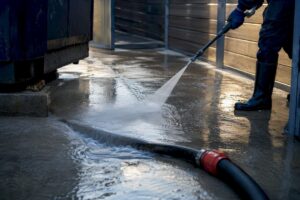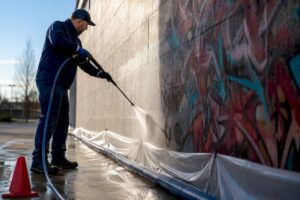
Expect to pay between $0.15 and $0.50 per square foot for professional concrete pressure washing, with most residential jobs carrying a $100 to $250 minimum regardless of size. A small patio typically runs $75 to $150, a standard driveway lands between $100 and $360, and a large garage floor with oil stains can climb past $400. The two biggest swing factors: how stained or aged the concrete is, and whether the job needs hot water or degreasing chemicals on top of a basic wash.
TL;DR:
- Heavy staining like oil, rust, or mildew can significantly increase costs due to the need for pretreatment, chemical dwell time, and possibly multiple passes.
- Surfaces that are sealed, stamped, or decorative require gentler techniques and lower pressure, which can raise labor and time costs to avoid surface damage.
- Hot-water pressure washing for grease and oil stains adds roughly $0.05 to $0.15 per square foot, reflecting equipment wear and fuel use as separate charges.
- Pricing models vary from per-square-foot rates to flat fees or time-based billing, with fixed setup costs often creating minimum service fees of $100 to $250.
- Properly matching quotes requires detailed measures, clear photos of stains, and disclosure of surface treatments to prevent surprise charges or damage.
Table of Contents
- What Does Concrete Pressure Washing Cost Per Square Foot?
- What Actually Drives the Price Up or Down?
- How Do Contractors Actually Build Their Quotes?
- Sample Budgets: What Real Quotes Look Like
- How Do You Get an Accurate, Comparable Quote?
- What Surprises Homeowners Most Often
- How Abcbins Handles Concrete Cleaning and Quotes
- Sources
What Does Concrete Pressure Washing Cost Per Square Foot?
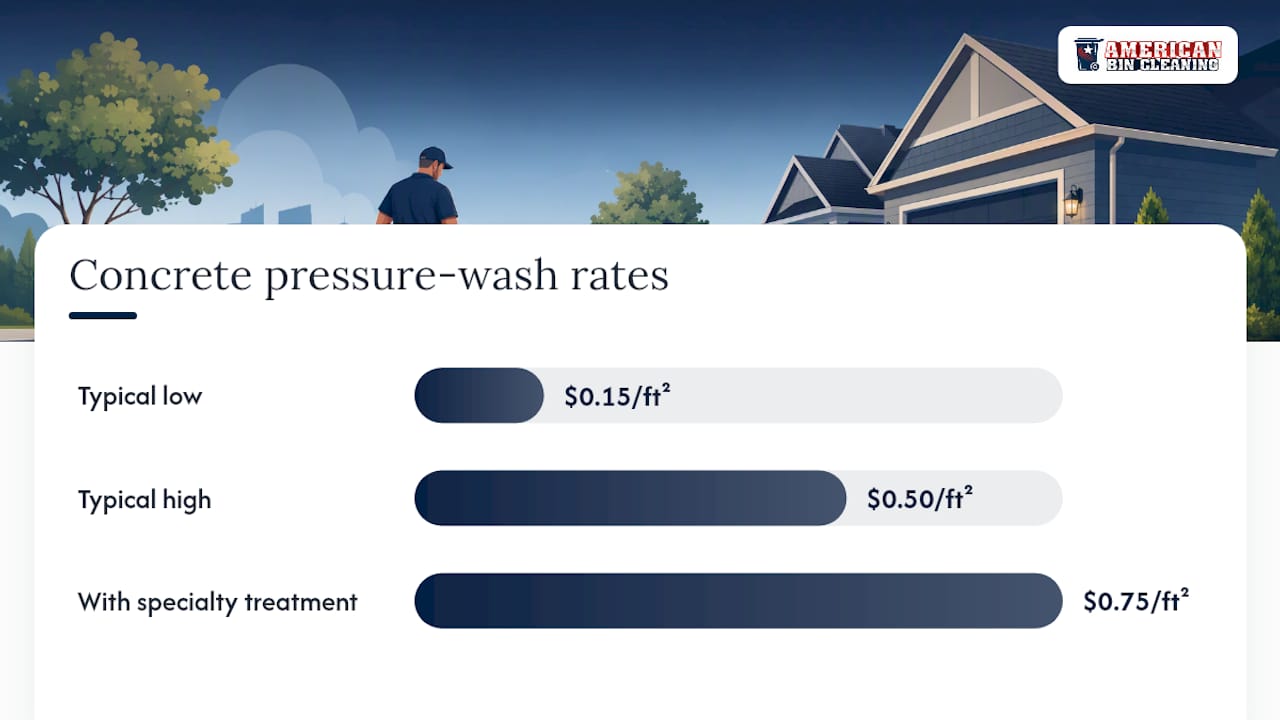
Plain, lightly soiled concrete sits at the bottom of the pricing scale. Contractors typically charge $0.15 to $0.50 per square foot for residential flatwork, with the low end reserved for clean, uniform surfaces and the high end covering decorative or heavily stained concrete that needs extra passes. Housecall Pro’s contractor pricing data backs this up, showing residential flatwork bands of $0.15 to $0.75 per square foot once specialty treatments get factored in.
Here’s how that translates into real job totals for common residential surfaces:
Notice that the small patio doesn’t scale down proportionally. That’s because minimum service fees, typically $100 to $250, cover the fixed cost of loading equipment, driving to the site, and setting up. A contractor loses money charging $0.30 per square foot on a 200 sq ft patio, since that only comes to $60. The minimum closes that gap.
A few things consistently push a quote toward the top of its range:
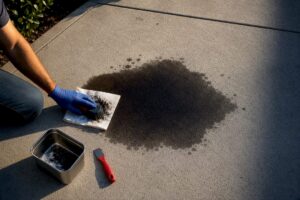
- Heavy oil, rust, or biological staining that requires pretreatment
- Decorative, stamped, or sealed concrete needing gentler technique
- Poor access (narrow gates, no water spigot, long hose runs)
- Hot-water equipment or industrial degreasers
- Jobs under 600 square feet that fall below the efficient scale point
Property managers overseeing multiple sites should expect per-square-foot rates to drop as total square footage climbs, since fixed setup costs get spread across more area. A 5,000 sq ft commercial lot rarely prices at the same per-foot rate as a single driveway.
What Actually Drives the Price Up or Down?
Two driveways of identical size can carry wildly different quotes, and the reason almost always comes down to condition, not square footage. A driveway with light dust and pollen might clean up with a single cold-water pass. The same driveway with years of motor oil, rust rings from old lawn furniture, or dark mildew staining needs pretreatment, dwell time for chemicals to break down the stain, and often a second pass. That extra labor and chemical cost shows up directly in the final number.
Stamped, colored, or sealed decorative concrete changes the approach entirely. High-pressure nozzles that work fine on plain gray concrete can etch sealed surfaces or strip color from stamped patterns. Consumer Reports coverage on pressure washing damage confirms that too much PSI or the wrong nozzle angle causes real damage on surfaces that aren’t plain, uncoated concrete. Contractors who know what they’re doing will drop pressure and widen the nozzle fan on decorative surfaces, which takes longer and often costs more.
Water temperature matters more than most homeowners realize. Cold water handles dirt, pollen, and light grime fine. Grease and old oil respond far better to hot water, which is why hot-water equipment carries its own upcharge rather than getting bundled into a flat rate. The fuel and equipment wear that hot-water units demand make this a legitimate line item, not an upsell trick.
Access and detail work add time in ways that don’t show up until the crew is on site. Stairs, tight edges along garden beds, and areas requiring hand-scrubbing around obstacles all eat into the schedule.
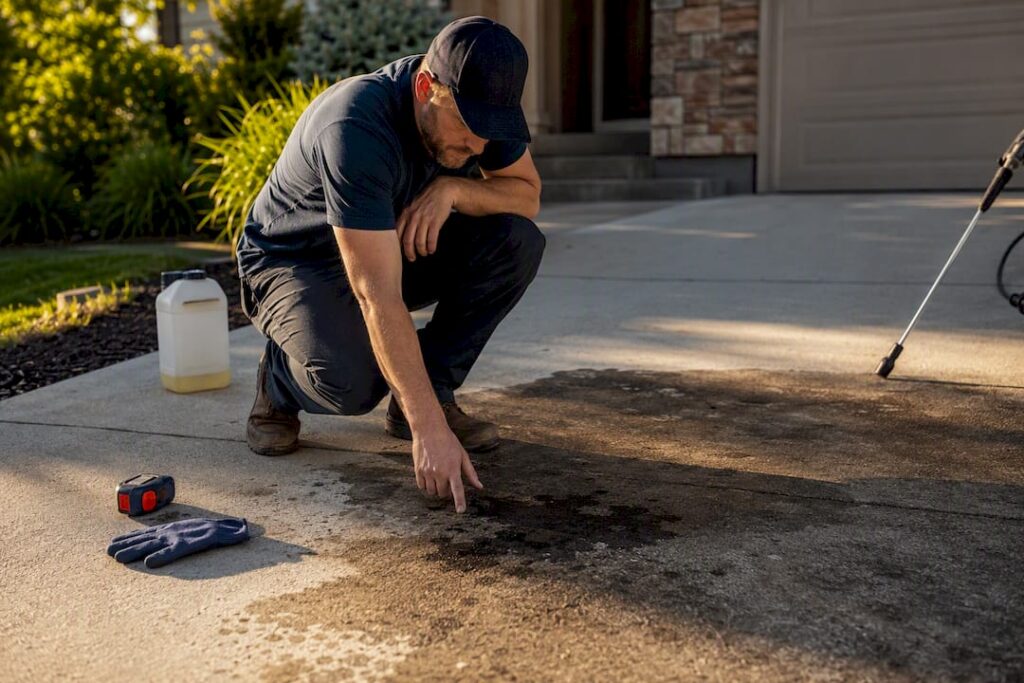
Pro Tip: Take a close-up photo of your worst stain before calling for quotes. A contractor who can see the actual staining gives you a far more accurate number than one guessing from “it’s got some oil spots.”
How Do Contractors Actually Build Their Quotes?
Most pressure-washing companies price using one of three models: straight per-square-foot rate, a flat rate for the whole job, or time-based billing for unpredictable jobs. Per-square-foot pricing dominates for driveways and patios because it scales cleanly. Flat-rate pricing shows up on jobs where the contractor has seen enough similar properties to estimate confidently without measuring. Time-based billing tends to appear on restoration-heavy jobs where nobody knows how long the oil removal will take until they start scrubbing.
Underneath any of those models sits the same four cost components:
- Labor: usually the largest share, driven by crew size and job duration
- Equipment: pressure washer fuel or electricity, surface cleaners, hose reels
- Chemicals: degreasers, mildewcides, and sealants when included
- Water and disposal: especially relevant where local rules require wastewater capture
Contractors calculate a break-even cost covering all four, then build in margin. The math is simple: final price equals break-even cost divided by (1 minus target margin). A job with $150 in break-even cost and a 30% target margin prices out to $150 ÷ 0.70, or about $214.
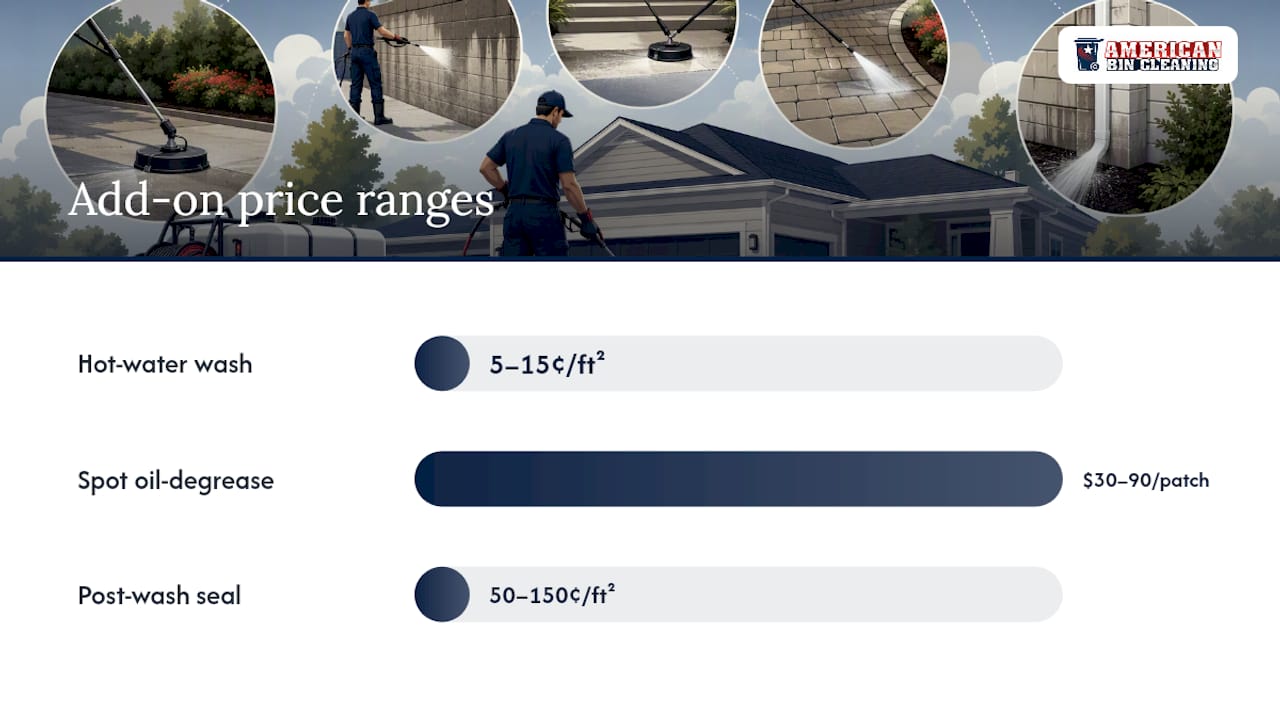
Common add-ons carry their own predictable ranges: hot-water washing adds roughly $0.05 to $0.15 per square foot, spot oil-degreasing runs $30 to $90 per patch, and post-wash sealing adds $0.50 to $1.50 per square foot.
Sample Budgets: What Real Quotes Look Like
Numbers only mean something in context, so here’s how the math plays out across five common scenarios homeowners and property managers actually book.
A blended pricing approach protects margins on the toughest spots without punishing the homeowner for the entire driveway. Contractors typically quote the bulk area at a baseline per-square-foot rate, then add a separate line for concentrated stains and another for sealing, keeping each cost visible rather than folding everything into one number.
That structure explains why commercial lots price so differently. A 3,000 sq ft lot at the $0.08 to $0.40 commercial band benefits from volume discounting that a single residential driveway never gets, since the fixed setup cost gets spread across far more square footage.
How Do You Get an Accurate, Comparable Quote?
Getting three quotes that actually mean something requires giving every contractor the same starting information. Vague requests get vague, wildly inconsistent numbers back.
- Measure the area in square feet, or at minimum give length and width for driveways and patios.
- Photograph the worst stains up close, along with a wider shot showing overall condition.
- Note any decorative, stamped, or sealed sections separately from plain concrete.
- Ask directly: What’s your minimum fee? How many passes are included? What chemicals do you use?
- Confirm water recovery and disposal practices, and ask for proof of insurance.
Watch for quotes with no line items at all, a flat number that seems too low for the square footage, or a contractor who can’t answer basic insurance questions. Those are the jobs that end up with surprise charges once the crew finds oil stains they didn’t account for.
Pro Tip: Bundling a driveway and a patio into one visit almost always beats booking them separately. You’re paying one mobilization fee instead of two, which can save $75 to $150 depending on the contractor’s minimum.
For jobs where condition is genuinely uncertain, accepting a photo-based remote estimate first (before scheduling an in-person walk-through) saves everyone time when the job turns out to be straightforward.
What Surprises Homeowners Most Often
The number one surprise on service calls: sealed and stamped concrete needs a completely different touch than plain slab. Homeowners who assume “concrete is concrete” are often shocked when a crew explains why their colored patio gets lower pressure and a wider nozzle instead of the aggressive blast they were expecting.
Oil spots are the second recurring surprise. What looks like a faint shadow on the surface often turns out to be decades deep into the pores of the concrete, requiring real dwell time with degreasers rather than a quick pass.
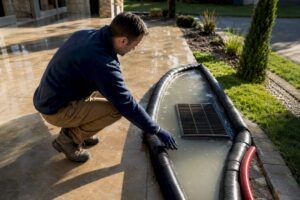
On the environmental side, homeowners increasingly ask where the dirty water goes. Systems that capture and recycle wastewater on board, rather than letting it run into storm drains, matter more to property managers than it did even a few years ago.
— Jim
How Abcbins Handles Concrete Cleaning and Quotes
Abcbins is the alternative to guessing at square footage and hoping a stranger’s flat quote is fair. We price driveways, patios, and garage floors in the Chicagoland area using clear per-square-foot bands, transparent minimum fees, and add-ons you approve before we start, not after.
Every quote from Abcbins spells out labor, chemicals, and any hot-water or degreasing upcharge as separate line items, so you know exactly what you’re paying for before a truck shows up. Our on-board wastewater recycling system means nothing runs off your driveway into the storm drain, a detail more property managers are asking about every year. We handle residential pressure washing services for driveways, patios, garage floors, and dumpster pads, and you don’t need to be home for any of it.
If you’re comparing quotes right now, request a quote from Abcbins and use our numbers as your benchmark against the rest.
Sources
- Price Per Square Foot to Pressure Wash Concrete: Realistic Cost Range and What Drives It 2026 – Current Cost
- Pressure Washing Pricing Guide: 2026 Rates & Pricing Tips — Housecall Pro