Pest prevention for remote suburban homes works best when you combine Integrated Pest Management (IPM) with physical exclusion, consistent sanitation, and targeted monitoring. The US EPA, CDC, and your County Cooperative Extension Service all point to the same framework: stop pests before they enter, remove what attracts them, and treat only when necessary. Here are the highest-impact moves to make right now:
- Seal every gap wider than a quarter-inch around pipes, vents, and the foundation
- Remove standing water from gutters, birdbaths, and low spots in the yard
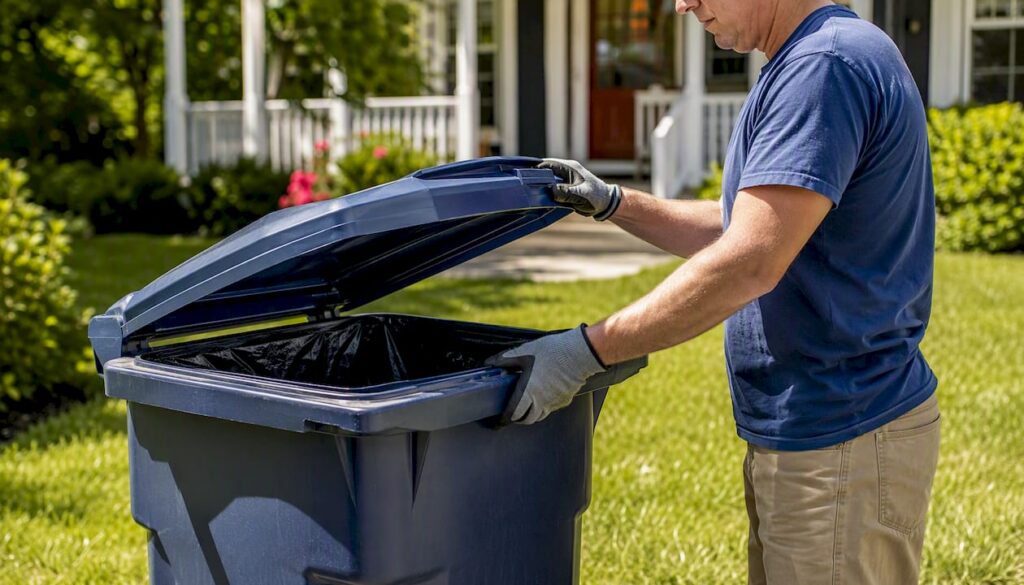
- Secure trash bin lids and schedule regular bin cleaning to eliminate odor-based attractants
- Inspect the attic and basement for droppings, chew marks, or moisture damage
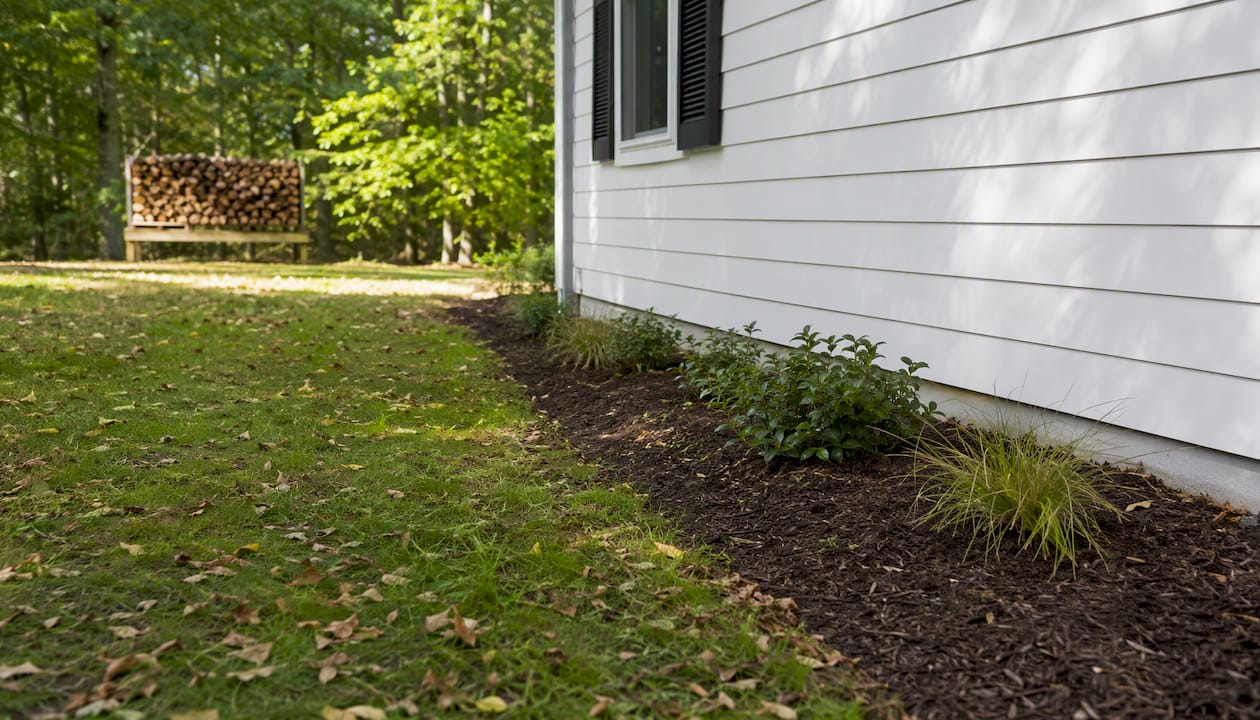
- Pull mulch and firewood at least 18 inches away from the house
- Contact your County Cooperative Extension Service for local pest identification and seasonal timing
Key Takeaways
Effective pest prevention for remote suburban homes requires IPM, physical exclusion, consistent sanitation, and regular monitoring working together as a system, not as isolated fixes.
| Point | Details |
|---|---|
| IPM is the foundation | Combine prevention, monitoring, and targeted controls; the EPA endorses this as the most effective framework for homeowners. |
| Exclusion stops entry | Seal gaps with steel wool and caulk, replace door sweeps, and cover vents with quarter-inch hardware cloth before fall. |
| Bin sanitation removes attractants | Residue in uncleaned bins draws rodents and raccoons; professional cleaning eliminates the odor signal that repellents cannot. |
| Yard management reduces habitat | Keep mulch 18 inches from the foundation, stack firewood 20+ feet away, and maintain a cleared buffer around outdoor structures. |
| Monthly monitoring catches problems early | A perimeter walk each month finds droppings, mud tubes, and new gaps before they become expensive infestations. |
| Abcbins supports your prevention plan | Professional bin cleaning on monthly, bi-monthly, or quarterly plans removes the attractant source that undermines other exclusion work. |
Table of Contents
- What can you do today to cut pest risk fast?
- Why IPM is the right approach for remote suburban homes
- How do you prevent specific pests common to suburban properties?
- How do you harden your home against pest entry?
- What yard practices reduce pest pressure around your property?
- Why does bin sanitation matter for suburban pest prevention?
- How often should you inspect, and what does prevention cost?
- When should you hire a licensed pest professional?
- Common mistakes that make pest problems worse
- How does community coordination reduce pest pressure?
- What actually works on remote suburban lots
- Clean bins, fewer pests: what Abcbins offers suburban homeowners
- Sources
What can you do today to cut pest risk fast?
You do not need a full inspection to reduce your exposure. These tasks take ten minutes or less and address the most common attractants immediately.
- Snap all trash bin lids shut and confirm the latch or bungee is secure.
- Bring in pet food bowls after each feeding — even a small amount of kibble draws rodents and raccoons overnight.
- Pick up fallen fruit, birdseed, and any organic debris from the yard.
- Drain anything holding water: saucers under planters, tarps, clogged gutters, and low spots on the driveway.
- Bag and tie kitchen scraps before placing them in the bin rather than tossing them in loose.
- Move firewood stacks at least 20 feet from the house if you have not already.
- Check door sweeps and window screens for tears or gaps you can feel air through.
Pro Tip: Bin cleaning frequency matters more than most homeowners realize. Monthly cleaning is worth it during summer when heat accelerates odor and bacterial buildup. Quarterly cleaning is a reasonable floor for cooler months. If your bin sat uncleaned through a hot stretch and you are suddenly seeing more flies or raccoon activity, an on-demand professional cleaning can reset the situation faster than any repellent spray.
Red flags that require a professional call today, not next week:
- Visible rodents during daylight hours (a sign of a large, established population)
- A swarm of winged insects emerging from walls, sills, or soil (possible termite swarm)
- Structural damage: soft wood, sagging floors, or gnawed wiring
- Raccoon or wildlife entry into the attic or crawlspace
Why IPM is the right approach for remote suburban homes
Integrated Pest Management is a decision-making framework, not a product. The EPA endorses IPM as the most effective and environmentally sensitive strategy for homeowners because it prioritizes prevention and monitoring over reflexive chemical use.
The four-tier structure works like this. First, prevention and exclusion: you remove food, water, and shelter so pests have no reason to stay. Second, monitoring: you inspect regularly to catch problems at the earliest, cheapest stage. Third, threshold decisions: you act only when pest numbers or damage cross a level that justifies intervention, not at the first sighting. Fourth, targeted controls: you choose the least-toxic effective method, whether that is a snap trap, a bait station, or a targeted pesticide applied precisely where pests travel.
Remote and wooded suburban lots raise the stakes on every tier. A larger perimeter means more potential entry points. Proximity to tree lines, wetlands, and wildlife corridors means a steady supply of pressure from rodents, ticks, mosquitoes, and larger animals. A property that backs up to woods is not just a house with a yard; it is a transition zone between human habitat and wildlife habitat, and pests exploit that edge constantly. That is exactly why the monitoring and exclusion tiers of IPM matter more here than they do for a dense urban row house.
IPM shifts pest control from a one-time spray to an ongoing system. EPA guidance is explicit: pest control should be a team effort rather than a reactive event.
How do you prevent specific pests common to suburban properties?
Prevention looks different depending on what you are dealing with. Here is what actually works, pest by pest.
Rodents (mice and rats)
Mice can squeeze through a gap the diameter of a pencil. Rats need only a quarter-inch. Seal every penetration point around pipes, cables, and the foundation with steel wool packed behind caulk or metal flashing. Keep the garage door closed, and do not leave dog food in the garage overnight.
- Check for droppings along walls, behind appliances, and in the attic
- Look for gnaw marks on wood, plastic, and wiring insulation
- Set snap traps along walls (not in open floor space) as your first-line control
Professional treatment is warranted when you find droppings in multiple rooms, hear activity in walls, or see a rodent in daylight.
Termites
Termites cause billions of dollars in structural damage annually in the US. The most effective prevention is removing wood-to-soil contact: keep lumber, mulch, and debris away from the foundation. Schedule a professional inspection each spring, particularly after a wet winter.
- Look for mud tubes on foundation walls and piers
- Tap exposed wood and listen for a hollow sound
- Check where wood meets concrete: sill plates, door frames, deck posts
A licensed termite professional with a baiting or liquid treatment program is the right call the moment you find mud tubes or swarmers.
Ants
Most ant problems start outside and follow a food or moisture trail indoors. Caulk gaps around windows and pipes, fix dripping faucets, and keep counters clean. Carpenter ants specifically target wet or rotting wood, so moisture control is the real fix.
- Trace the trail back to the entry point and seal it
- Use bait stations rather than contact sprays, which scatter colonies without eliminating them
Mosquitoes
A single container holding a tablespoon of stagnant water can produce hundreds of mosquitoes. Drain everything weekly during warm months. For larger water features, use Bacillus thuringiensis israelensis (Bti) dunks, which kill larvae without harming other wildlife.
- Empty and scrub birdbaths twice a week
- Check gutters for standing water after every rain
- Treat late May through September as peak season for tick and mosquito habitat reduction
Ticks
Ticks live in the transition zone between lawn and woods, exactly where remote suburban yards tend to end. The CDC recommends keeping grass mowed short, creating a three-foot wood chip or gravel barrier between the lawn and wooded areas, and treating clothing and gear with permethrin for outdoor work.
- Check yourself and pets after every outdoor activity
- Remove leaf litter from the yard perimeter in fall
- Consider acaricide treatment by a licensed applicator in late spring if tick pressure is high
Raccoons and wildlife
Raccoons are smart, persistent, and attracted primarily by food odors. Bearwise recommends securing garbage in latched, wildlife-resistant containers and bringing bins inside or into a garage until collection morning. On wooded lots, that advice applies to raccoons and opossums as much as bears.
- Never leave pet food outside overnight
- Use motion-activated lighting near bins and entry points
- Contact your state wildlife agency if an animal has entered the structure
Bed bugs and cockroaches
Both pests travel on people and objects, not through the yard. Inspect secondhand furniture before bringing it inside. For cockroaches, eliminate moisture under sinks and behind appliances, and seal gaps around plumbing. A professional treatment is almost always necessary for bed bugs; DIY approaches rarely eliminate an established population.
You can use Insectidentification to confirm a species before choosing a control method, which saves both time and money.
How do you harden your home against pest entry?
Physical exclusion is the single highest-return investment in pest prevention. Done once and maintained annually, it reduces pest pressure across every species simultaneously.
Start with the foundation and exterior walls:
- Walk the full perimeter and probe every penetration point: gas lines, electrical conduit, hose bibs, dryer vents, and AC lines
- Fill gaps smaller than half an inch with paintable exterior caulk
- Pack rodent-sized gaps with steel wool before caulking; rodents chew through foam alone
- Replace damaged soffits and eaves, which are primary entry points for squirrels and bats
Doors and windows:
- Install or replace door sweeps on all exterior doors, including the garage
- Check weatherstripping for compression failure; you should not see light around a closed door
- Repair or replace any torn window or door screen; a half-inch tear is enough for a mouse
- Winterizing your doors properly also seals the gaps that pests exploit in fall; One Day Doors & Closets covers the process in detail
Vents and attic access:
- Cover all crawlspace and attic vents with 16-gauge galvanized hardware cloth (quarter-inch mesh)
- Check roof vents and ridge caps after every major storm
- Inspect the chimney cap annually; open chimneys are a common raccoon and bird entry point
Moisture and ventilation:
Damp crawlspaces and poorly ventilated attics attract termites, carpenter ants, and rodents. Fixing a moisture problem often resolves a pest problem without any chemical treatment.
Pro Tip: Do your fall rodent-proofing in September, before temperatures drop and mice start actively seeking warmth. By October, they are already inside. A two-hour perimeter walk with a tube of caulk and a roll of hardware cloth in September is worth more than a professional treatment in November.
What yard practices reduce pest pressure around your property?
The yard is where pest prevention starts, not the house. Reducing habitat and food sources outside cuts the population that ever reaches your walls.
| Landscape practice | Target pest outcome |
|---|---|
| Keep mulch 18 inches from foundation | Reduces termite and ant harborage near the structure |
| Stack firewood at a distance from the house and off the ground | Removes rodent and termite harborage adjacent to entry points |
| Maintain drainage and clear gutters | Eliminates mosquito and ant breeding sites |
| Mow lawn short, thin dense plantings | Reduces tick habitat in the transition zone |
| Maintain a cleared buffer of several feet around playsets and furniture | Cuts tick and mosquito exposure in high-use areas |
Consumer Reports recommends mowing regularly, thinning dense plantings, and maintaining cleared buffers around outdoor structures as reliable measures to reduce pest habitat. On a large suburban lot, that means treating the area immediately around the house as a managed zone, not a natural extension of the woods.
A few additional points worth making:
Native plants generally support fewer pest-host relationships than ornamentals that are stressed by local conditions. A stressed plant attracts aphids and scale insects, which in turn attract ants. Healthy, well-sited plants resist infestation better than anything you can spray on them.
Pool and water feature maintenance belongs in this category too. Keep pool water properly chlorinated, and run a fountain pump to prevent mosquito larvae from developing. Standing water in a decorative pond without a pump or fish is a mosquito nursery.
Pro Tip: If your property backs up to woods, consider a gravel or wood-chip buffer strip along the tree line rather than letting grass grow to the edge. That strip is inhospitable to ticks and gives you a visual inspection lane where you can spot rodent burrows and wildlife trails.
Why does bin sanitation matter for suburban pest prevention?
Garbage bins are one of the most effective pest attractants on any property, and one of the most overlooked. The EPA’s guidance on pest prevention is direct: removing food sources is a core prevention step. A bin that has not been cleaned in months is not just smelly; it is broadcasting a food signal to every rodent, raccoon, and fly within range.
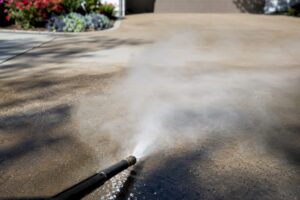
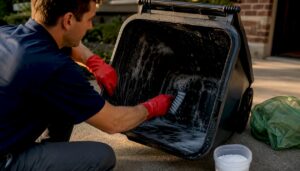
The problem is the residue, not just the current contents. Organic material left in the bin after collection ferments, concentrates, and creates an odor that persists even after the trash is gone. That residue is what draws pests back to the same spot week after week. Deep cleaning your trash cans removes that residue in a way that rinsing with a garden hose simply cannot.
What a professional bin-cleaning visit addresses:
- High-pressure hot water that reaches the bottom and sides of the bin, not just the visible interior
- Sanitizing agents that eliminate bacterial residue and the odors it produces
- Wastewater capture so contaminated water does not run into the yard or storm drain
- Deodorizing treatment that reduces the attractant signal between cleanings
Consider a scenario common on wooded suburban lots: a homeowner notices raccoon activity around the bins every few nights despite using a bungee cord on the lid. After a professional cleaning that removes months of residue, the raccoon visits drop off within a week. The bungee was never the problem; the odor signal was. Pairing bin sanitation with wildlife prevention addresses both the access problem and the attractant problem together.
Pro Tip: Schedule bin cleaning immediately after a holiday weekend or a summer cookout. Those are the periods when grease, meat residue, and sugary waste accumulate fastest. Waiting until the next scheduled quarterly cleaning gives pests weeks of uninterrupted access to a high-odor attractant.
How often should you inspect, and what does prevention cost?
Monitoring is what turns IPM from a theory into a working system. Without regular checks, small problems become expensive ones.
| Inspection type | Who performs it | Recommended frequency | Typical time |
|---|---|---|---|
| Perimeter walk (exterior) | Homeowner | Monthly | 20 minutes |
| Interior check (attic, basement, crawlspace) | Homeowner | Seasonal (4x/year) | 45 minutes |
| Post-storm exterior check | Homeowner | After significant storms | 10 minutes |
| Professional inspection | Licensed pest control firm | Annually (or as needed) | 60 minutes |
During a homeowner perimeter walk, look for droppings, mud tubes along the foundation, chew marks on wood or plastic, nests in shrubs or eaves, and new gaps or cracks. These are the early signals that catch problems before they require a professional.
On costs: preventative pest control services typically run less per visit than reactive treatments, and the gap widens significantly for structural pests. A termite baiting program costs a fraction of what structural repair runs after an established colony has been active for two or three years. General preventative pest control visits for a suburban home tend to fall in a moderate range depending on property size, pest type, and region; reactive treatments for active infestations cost meaningfully more and often require multiple visits. Your County Cooperative Extension Service can provide local cost benchmarks and referrals to licensed professionals in your area.
When should you hire a licensed pest professional?
DIY prevention handles a lot, but there are clear situations where professional help is not optional.
Call a licensed pro when you observe:
- Rodent activity in multiple rooms or evidence of nesting inside walls
- Mud tubes, swarmers, or hollow-sounding wood (termite indicators)
- Bed bugs confirmed by visual identification
- Wildlife entry into the structure (attic, crawlspace, walls)
- Recurring pest activity after two or more rounds of DIY treatment
- Any structural damage you suspect is pest-related
Questions to ask before hiring:
- Are you licensed by the state? (Firms must hold a state pesticide applicator license; verify through your state’s pesticide regulatory agency or the EPA locator)
- Do you use an IPM approach, or is your default a scheduled spray program?
- What pesticides do you plan to use, and can you provide the label and SDS?
- Do you carry liability insurance and a warranty or follow-up guarantee?
- Will you provide a written inspection report and treatment plan before starting?
The EPA’s Citizen’s Guide to Pest Control covers exactly what to look for when hiring a pest control company, including how to evaluate pesticide safety and what alternatives to ask about. PestWorld also maintains a directory of pest management professionals and educational resources on common pest behaviors.
A good contractor delivers a written inspection report, identifies the pest species and likely entry points, proposes a treatment plan with specific products and application sites, and schedules a follow-up. If a company quotes a price over the phone without an inspection, that is a red flag.
Common mistakes that make pest problems worse
Most recurring infestations have a human behavior at the root, not a gap in the foundation.
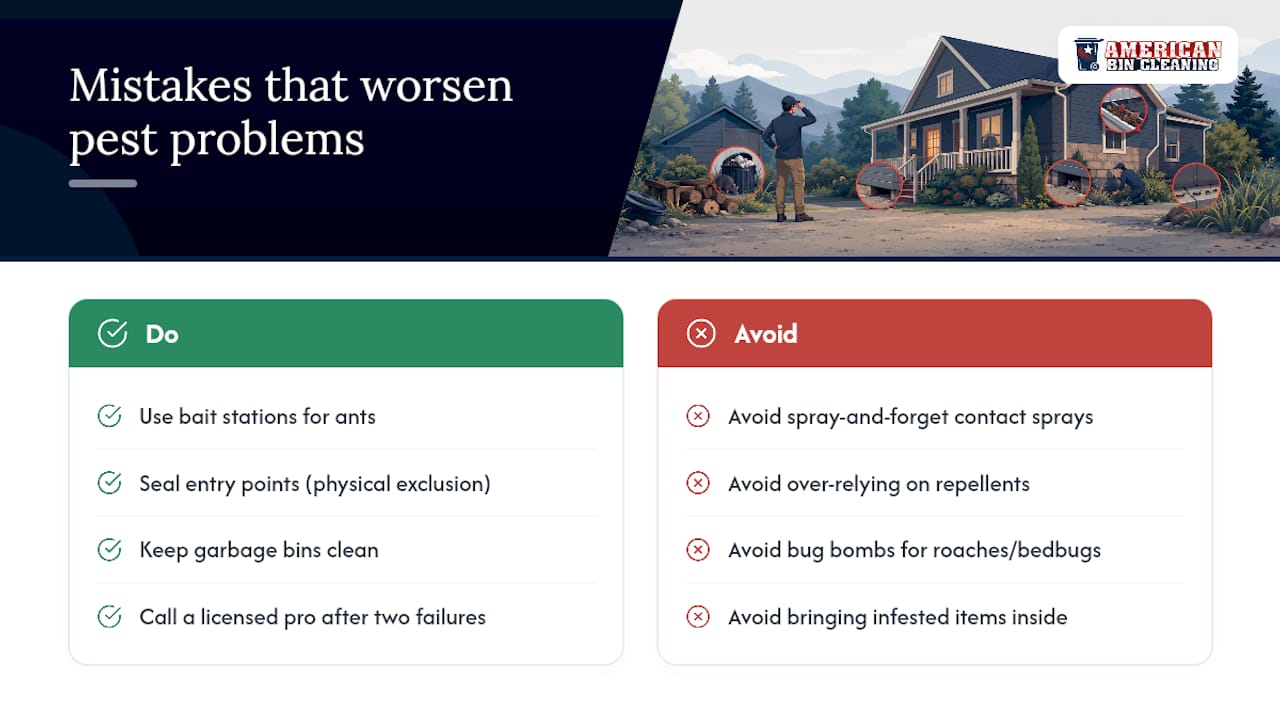
Spray-and-forget. Contact sprays kill what they touch and scatter the rest. A colony of ants treated with a surface spray often splits and re-establishes in two locations. Bait stations work because they let foragers carry the active ingredient back to the colony. Use the right tool for the job.
Over-relying on repellents. Ultrasonic repellent devices have not demonstrated consistent effectiveness in controlled studies. Mothballs placed in attics or crawlspaces create a toxic vapor hazard without reliably excluding rodents. Neither replaces physical exclusion.
Bug bombs for cockroaches or bed bugs. Total-release foggers scatter insects into wall voids and adjacent rooms without penetrating harborage sites. For cockroaches, gel bait applied in cracks and crevices outperforms foggers. For bed bugs, professional heat treatment or targeted insecticide application by a licensed applicator is the standard of care.
Ignoring bin sanitation. Spraying the yard perimeter while leaving a filthy, odor-saturated bin at the curb is like mopping the floor with a dirty mop. The attractant signal overwhelms the deterrent. Avoiding common garbage bin cleaning mistakes is as important as the cleaning itself.
Moving infested items inside. Bringing secondhand furniture, cardboard boxes from a storage unit, or firewood directly into the living space without inspection is one of the most reliable ways to introduce bed bugs, cockroaches, and wood-boring beetles.
Pro Tip: If you have tried two rounds of DIY treatment for the same pest and the problem persists, stop. Each failed attempt gives the pest population time to adapt to your approach and can make a professional treatment harder. Call a licensed pro after the second failure, not the fifth.
How does community coordination reduce pest pressure?
Pest prevention on a single property is more effective when neighbors coordinate. Rodent populations, mosquito breeding sites, and tick habitat do not respect property lines. A neighbor’s uncleaned bins, overgrown lot, or unmanaged compost pile can sustain a pest population that repeatedly recolonizes your property no matter how well you have exclusion-proofed your own house.
The most practical starting point is your County Cooperative Extension Service. Extension offices provide free or low-cost pest identification, local pest calendars, and recommendations calibrated to your specific region and climate. Many counties run community IPM programs, tick surveillance networks, and mosquito abatement districts that homeowners can tap into at no cost.
Neighborhood associations can coordinate shared actions: a block-wide cleanup of standing water before mosquito season, a shared schedule for professional bin cleaning, or a group termite inspection program that covers multiple properties at a lower per-home cost. Some municipalities offer subsidized mosquito control or rodent abatement programs for residential areas; your local health department is the right contact.
For wooded suburban communities near wildlife corridors, coordinating wildlife-resistant bin practices across the neighborhood matters. A single household leaving unsecured bins out overnight sustains the local raccoon population for the entire street. Sharing resources like BearWise.org with neighbors is a low-effort, high-impact step.
What actually works on remote suburban lots
The conventional pest-control conversation focuses on what to spray. After years of working with homeowners across wooded suburban properties, the pattern that stands out is different: the homes with the fewest recurring pest problems are the ones where sanitation, exclusion, and monitoring run together as a system, not as separate one-off fixes.
Bin cleaning is a good example of a step that gets dismissed as cosmetic until it is not. A homeowner who seals every gap in the foundation but leaves a residue-coated bin at the curb is still broadcasting an attractant signal that draws rodents and raccoons to the property perimeter. Once they are at the perimeter, they find the gaps. The exclusion work and the sanitation work reinforce each other; neither is sufficient alone.
The same logic applies to landscape management. Pulling mulch back from the foundation and stacking firewood away from the house are not dramatic interventions, but they remove the harborage that makes exclusion work irrelevant. A mouse that has no cover to cross the open ground between the wood pile and the house is a mouse that is less likely to reach the wall.
What homeowners typically underestimate is how much the monitoring cadence matters. A monthly perimeter walk catches problems when they are still cheap: a new gap, a fresh mud tube, a small rodent trail. Waiting for visible evidence inside the house means the problem has already been established for weeks or months.
Clean bins, fewer pests: what Abcbins offers suburban homeowners
Bin sanitation is one of the highest-impact, lowest-effort pest prevention steps available to suburban homeowners, and it is the one most consistently skipped. Abcbins provides professional trash bin cleaning on service plans built around your schedule: monthly, bi-monthly, quarterly, or on-demand when you need a reset after a holiday or a hot stretch.
Every visit uses eco-friendly, high-pressure hot water to sanitize the bin interior, eliminate odor-producing residue, and capture all wastewater on-board so nothing runs into your yard or storm drain. You do not need to be home. Abcbins handles everything curbside and leaves the bin clean, deodorized, and far less attractive to the raccoons, rodents, and flies that treat an unclean bin as a reliable food source.
If you are in the Chicagoland area, book a bin cleaning in Barrington or check service availability for your neighborhood. Pairing a regular cleaning plan with the exclusion and landscape steps in this guide gives you a pest prevention system that actually holds.
Sources
The following sources informed this guide and are worth bookmarking for ongoing reference:
- Integrated Pest Management (IPM) principles — US EPA
- How to Get Rid of Any Pest in Your Home or Yard—for Good — Consumer Reports
- PestWorld