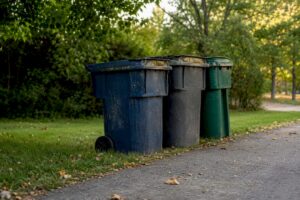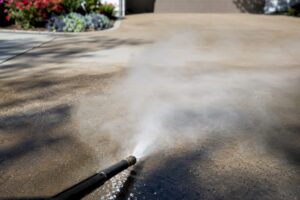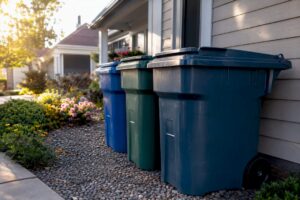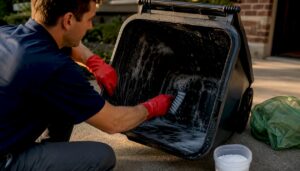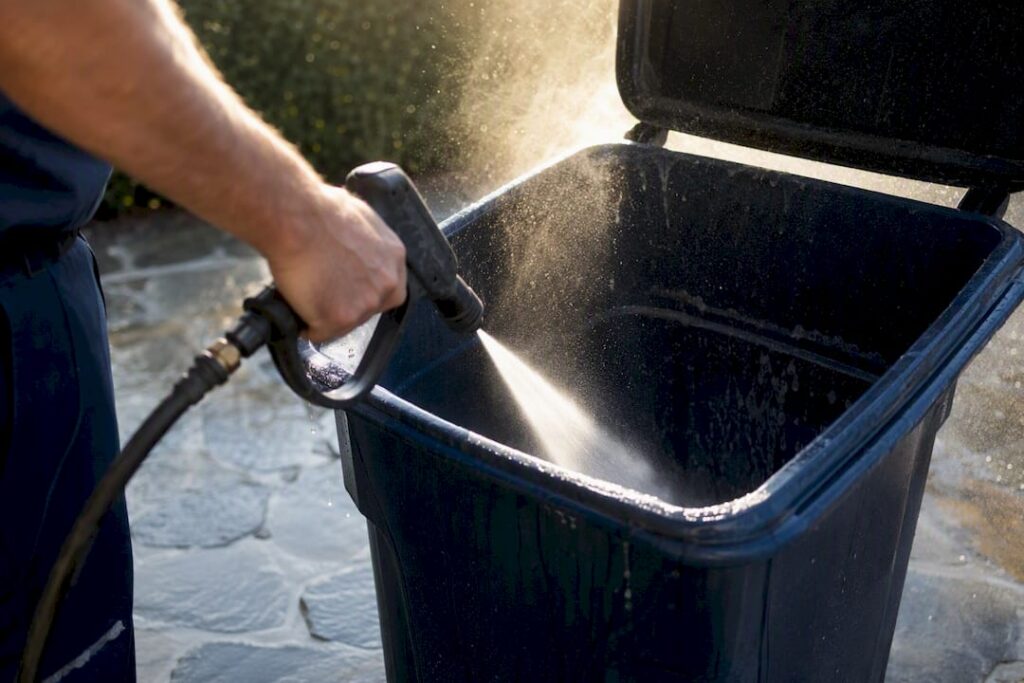
The bacteria most commonly found in household and commercial trash bins are E. coli, Salmonella, Listeria, Pseudomonas, Staphylococcus aureus, and Klebsiella, and they don’t rinse away with a garden hose. These organisms build up in a protective layer called biofilm that clings to plastic, and the only reliable fix is hot, high-pressure professional sanitation. Abcbins reports that its process eliminates nearly all bacteria while capturing all wastewater on board, so nothing runs off into your yard or storm drain.
Common bin bacteria include:
- E. coli — from raw meat juices and diaper waste
- Salmonella — from poultry packaging and spoiled produce
- Listeria — from dairy spills and deli waste
- Pseudomonas — thrives in standing liquid and slime layers
- Staphylococcus aureus — spread through skin contact and pet waste
- Klebsiella — common in decaying organic matter and diapers
If your household includes young kids, older adults, or anyone immunocompromised, or if you’re dealing with heavy food waste, persistent odors, or a pest problem, that’s your cue to schedule professional cleaning rather than wait it out.
Key Takeaways
Professional hot water and high-pressure sanitation removes the biofilm that traps E. coli, Salmonella, Listeria, and other common bin bacteria, which household rinsing and bleach cannot safely or effectively achieve.
| Point | Details |
|---|---|
| Know your bacteria | E. coli, Salmonella, Listeria, Pseudomonas, Staph aureus, and Klebsiella are the usual suspects in dirty bins. |
| Skip the bleach | Mixing bleach with ammonia residue creates toxic chloramine gas; never pour it into a closed bin. |
| Biofilm resists rinsing | Cold water and garden hoses leave the protective bacterial layer intact even after visible grime is gone. |
| Match frequency to risk | Monthly cleaning suits homes with diapers, pets, or heavy food waste; quarterly works for low-traffic bins. |
| Book professional sanitation | Abcbins uses hot, high-pressure cleaning with on-board wastewater capture to cut bacteria and stop runoff. |
Table of Contents
- Why Common Bin Bacteria in Lake and Suburb Homes Matter for Your Health
- Common Microbes in Bins and Why They Stick Around
- How Professional Bin Cleaning Breaks Down Biofilm
- The DIY Mistakes That Make Things Worse
- How Often You Should Actually Schedule a Cleaning
- What a Curbside Cleaning Visit Looks Like
- What 37 Years of Bin Cleaning Has Taught Us
- Book a Bin Cleaning That Actually Solves the Problem
- Frequently Asked Questions
- Sources
Why Common Bin Bacteria in Lake and Suburb Homes Matter for Your Health
Every time a bin lid opens or a bag gets tossed in, it can release a small burst of bacteria and fungi into the air right where you’re standing. Researchers call this a bioaerosol, and it’s one reason bin hygiene isn’t just about smell.
Cross-contamination happens in ordinary ways: a kid touches the bin lid then their face, a dog sniffs the rim then licks a hand, shoes track residue from the garage into the kitchen. For most healthy adults, this is a minor nuisance. It’s a different story for:
- Children under 5, whose immune systems are still developing
- Elderly household members with slower-healing immune responses
- Anyone immunocompromised from illness or treatment
Statistic callout: Foodborne illness is wildly underreported. For every confirmed Salmonella case, an estimated 26 additional cases go unreported. The stomach bug your family blamed on a restaurant might have started at the curb.
Common Microbes in Bins and Why They Stick Around
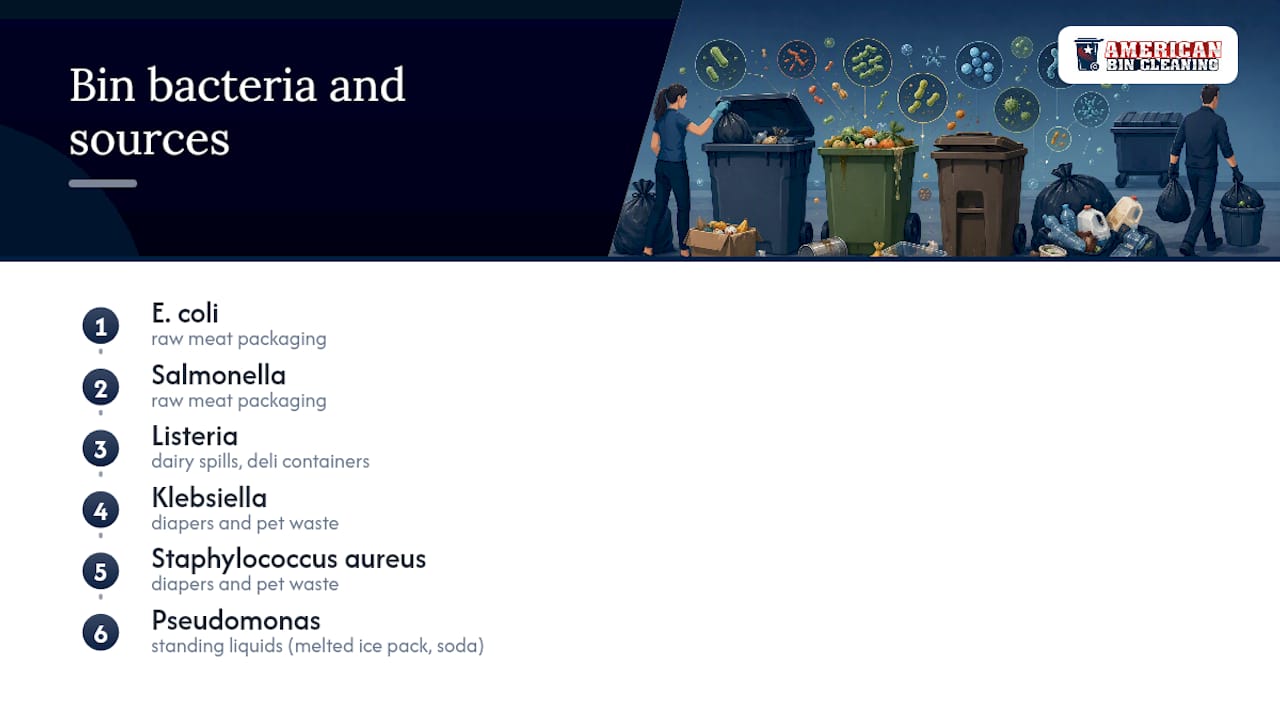
Each bacterial strain tends to have a favorite entry point. Raw meat packaging seeds E. coli and Salmonella. Dairy spills and deli containers feed Listeria. Diapers and pet waste are reliable sources of Klebsiella and Staph aureus. Standing liquid at the bottom of a bin, whether it’s melted ice pack water or old soda, becomes a breeding ground for Pseudomonas.
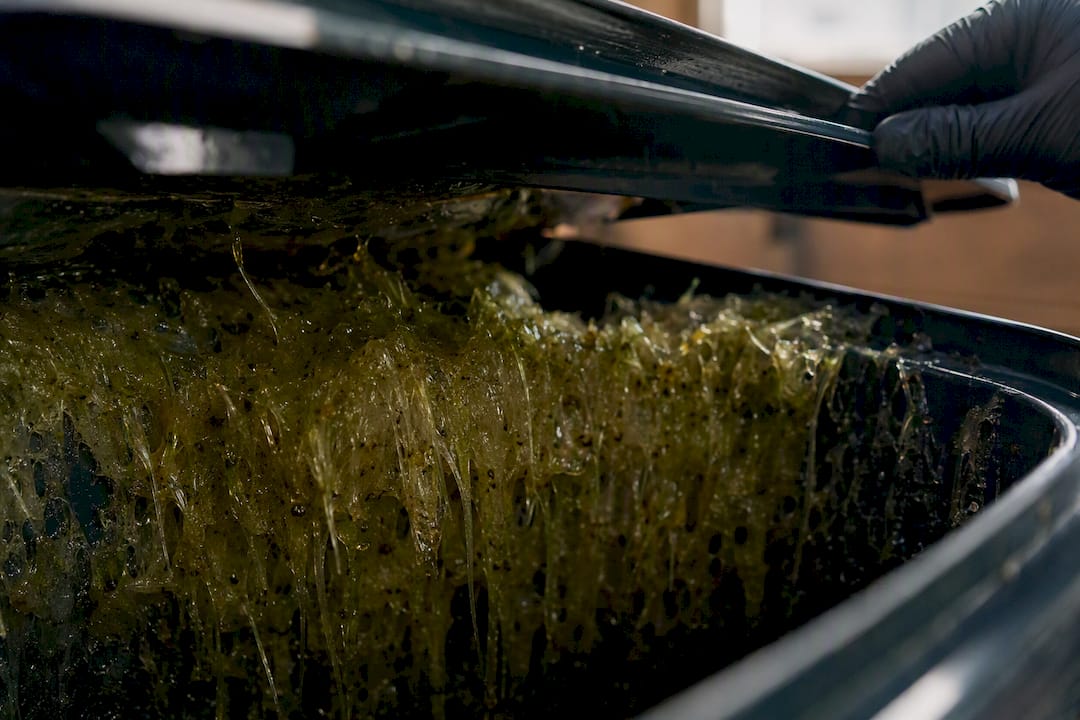
What makes these bacteria hard to shift is biofilm, a slimy matrix that microbes secrete to glue themselves to plastic. Once formed, it can protect bacteria for days or weeks even after a rinse. A garden hose knocks loose the visible gunk and leaves the biofilm layer intact underneath.
There’s also a broader environmental pattern worth knowing about: a 2025 study found multidrug-resistant Enterococcus species colonizing public trash bins in urban settings. That doesn’t mean your driveway bin is a resistant-superbug factory, but it’s a reminder that bins function as an overlooked microbial habitat, not just a waste container.
How Professional Bin Cleaning Breaks Down Biofilm
Cutting through biofilm takes more than soap and elbow grease. Professional systems combine superheated water, typically heated above warm temperatures effective for sanitization, with high pressure and rotating scrubbing heads that physically dislodge the slime layer while sanitizers finish the job on what remains. Cold water alone rarely touches embedded biofilm, which is why the same bins that get hosed down every week still smell by August.
Here’s what each part of the process does:
- Hot water loosens grease and breaks down the biofilm matrix
- High pressure physically strips residue from ridges and corners standard hoses can’t reach
- Rotating nozzles clean 360 degrees inside the bin, not just the visible surfaces
- Sanitizing agents address bacteria that survive the mechanical cleaning
Abcbins built its process around one more piece most homeowners never think about: where the dirty water goes. The truck’s on-board recycling system captures all wastewater used during cleaning, so nothing drains into your lawn, the storm sewer, or a nearby lake. That matters more in lake-adjacent suburbs, where runoff has somewhere real to go.
Service plans vary by household need. A family with young kids or heavy food waste typically fits a monthly plan, while a lower-traffic household might do fine on a bi-monthly or quarterly rotation. On-demand cleanings work well after a big party or a particularly rank garbage week.
Pro Tip: Book your bin cleaning a day or two before your regular pickup, not right after. Bins are dirtiest and most odor-prone right before collection, so that’s when a professional visit does the most good.
The DIY Mistakes That Make Things Worse
The instinct to reach for bleach is understandable and genuinely risky. If a bin has any ammonia-based residue, from urine, some cleaning products, or certain fertilizers, mixing in bleach produces chloramine gas, a toxic respiratory irritant. The Washington State Department of Health warns against this exact combination for good reason.
Bleach and ammonia don’t neutralize each other. They react, and the byproduct is a gas that can seriously irritate your lungs and eyes in an enclosed space like a bin.
Vinegar, dish soap, and cold garden-hose rinses aren’t dangerous, but they’re mostly cosmetic. They knock down odor temporarily without touching the biofilm underneath, and the runoff often just pools in the driveway or yard.
Until you can book a professional cleaning, double-bag leaking food waste, keep the lid closed between uses, store bins away from doorways, and wear gloves if you have to reach inside.
How Often You Should Actually Schedule a Cleaning
Frequency depends more on what’s going into the bin than the calendar.
- Monthly cleaning fits households with diapers, pet waste, or raw meat packaging going in regularly, plus anyone in a warmer climate where bacteria multiply faster.
- Bi-monthly works for average households with typical food waste and no major risk factors.
- Quarterly suits low-traffic bins, like a rarely used commercial dumpster or a vacation property.
- Bump up frequency whenever you have a large family, host frequent gatherings, or your municipality has missed a pickup, since extended storage measurably increases bioaerosol and endotoxin levels.
A single cleaning helps, but germ load creeps back fast. A recurring plan keeps the baseline low instead of chasing the problem after it’s already visible or smelly.
What a Curbside Cleaning Visit Looks Like
A typical visit is quick and doesn’t require you to be home. The technician pulls up on service day, connects your bin to the truck’s system, and runs it through the hot water and pressure cycle right at the curb, inside and out, lid included. All the runoff goes into the truck’s own capture tank rather than your driveway.
Pricing generally follows one of two shapes: a flat per-bin rate for a one-time cleaning, or a discounted recurring rate tied to a monthly, bi-monthly, or quarterly plan. What you pay usually depends on:
- Bin size and how many you’re having serviced
- Whether it’s a one-time visit or a recurring plan
- Commercial dumpster pads versus residential cans
Before booking with any provider, ask these questions:
- Where does the wastewater go after cleaning?
- What sanitizer do they use, and is it safe around kids and pets?
- Are they insured, and what happens if something’s damaged?
- What’s their cancellation or reschedule policy?
- Do they offer a discount for recurring service?
What 37 Years of Bin Cleaning Has Taught Us
Every homeowner asks some version of the same question first: “Is this actually necessary, or is it just a nice-to-have?” After decades of servicing bins across suburban and lake communities, the pattern is consistent. The households that call us are almost always dealing with a smell that won’t quit, a fly problem that started at the curb, or a new baby in the house that suddenly made “good enough” feel risky.
What surprises people is how fast biofilm rebuilds once it’s established, and how little a weekly hose-down actually does against it. Suburban and lake-area properties see this more, not less because of warmer, humid stretches that speed up bacterial growth.
Book a Bin Cleaning That Actually Solves the Problem
If you’ve made it this far, you already know a garden hose isn’t cutting it. Abcbins has been family-owned since 1989, and our eco-friendly, high-pressure process is built specifically to strip biofilm that ordinary rinsing leaves behind, cutting bacterial load by a claimed 99.99% without dumping wastewater into your yard or a nearby lake.
We offer curbside cleaning on monthly, bi-monthly, quarterly, or on-demand plans, plus dumpster pad cleaning for commercial properties and pressure washing for driveways, decks, and storefronts. You don’t need to be home. We show up, clean, and capture every drop of wastewater in our on-board recycling system before we leave.
If you’re in northern Illinois or southern Wisconsin, check out trash bin cleaning options near you or see service details for lake-area homes to pick a plan and get on the schedule.
Frequently Asked Questions
What bacteria are most commonly found in trash bins?
E. coli, Salmonella, Listeria, Pseudomonas, Staphylococcus aureus, and Klebsiella show up most often, typically traced back to raw meat packaging, dairy spills, diapers, and pet waste.
Can dirty bins actually make my family sick?
Yes, particularly for children under 5, older adults, and anyone immunocompromised. Cross-contamination happens through hands, shoes, and pets touching contaminated surfaces, and foodborne illness is significantly underreported.
Is it safe to clean my bin with bleach?
Only if you’re certain there’s no ammonia-based residue inside, which is hard to guarantee. The safer move is professional sanitation that skips the chemical guesswork entirely.
How often should suburban or lake-area homes get bins cleaned?
Monthly for households with diapers, pet waste, or heavy food scraps; bi-monthly or quarterly for lower-traffic bins. Warmer, humid conditions common near lakes tend to push that timeline shorter.
Does professional bin cleaning hurt the environment?
A well-run service captures wastewater on board rather than letting it run off, which matters especially for properties near lakes and waterways where runoff has somewhere to go.
This article is general information, not a substitute for advice from a qualified doctor. Consult a qualified healthcare professional about your own circumstances before acting on anything here.
Sources
- Foodsafety
- Bleach mixing dangers — Washington State Department of Health
- Bioaerosol generation during waste handling — PubMed