Hire a licensed commercial contractor experienced with fuel stations, and make sure that contractor captures and treats every drop of washwater before it touches a storm drain. That single requirement separates a service that protects you from fines and slip-and-fall claims from one that quietly transfers liability onto your property. Look for insurance, documented best management practices, and after-hours scheduling that keeps pumps open during the job.
TL;DR:
- Ensure the contractor captures and treats all washwater, especially from dispenser skirts and drain inlets, to prevent environmental runoff violations.
- Confirm that the scope includes all areas like pumps, canopies, drive lanes, storefronts, and dumpster pads, not just the forecourt.
- Verify the contractor has proper insurance, documented BMPs, trained crew, and proof of wastewater recovery before signing a contract.
- Household or unlicensed vendors often overlook wastewater rules, increasing the risk of fines due to contaminated runoff discharging into storm drains.
- Schedule pressure washing based on traffic volume, typically monthly for pump islands and dumpster pads, with after-hours work to avoid disrupting operations.
Table of Contents
- What Areas Does Gas Station Pressure Washing Actually Cover?
- Why Does Professional Pressure Washing Matter for Gas Station Safety?
- What Wastewater Rules Apply to Gas Station Cleaning?
- What Cleaning Process Should a Gas Station Contractor Follow?
- How Often Should Gas Stations Schedule Pressure Washing?
- How Do You Vet a Gas Station Pressure Washing Contractor?
- Why American Bin Cleaning Fits the Compliance Standard
- A Few Things I’d Insist on Before Signing Any Contract
- Get a Site Assessment for Your Fuel Station
- Sources
What Areas Does Gas Station Pressure Washing Actually Cover?
A proposal that only mentions “the forecourt” is missing half the job. Fuel stations accumulate contaminants in predictable spots, and a thorough gas station pressure washing scope should name each one specifically, not bundle them into a vague line item.
- Fuel pump islands and pump aprons: gasoline drips, diesel residue, motor oil, and gum buildup that make concrete slick within days.
- Canopy undersides and support columns: soot from exhaust, bird droppings, and grime around light fixtures that dulls the whole forecourt’s appearance.
- Forecourt concrete and drive lanes: tire marks, oil staining, and winter salt residue that etch into porous concrete over time.
- Storefront exteriors, curbs, and expansion joints: gum, spilled beverages, and cracks where odor and pests take hold.
- Dumpster pads: grease and food waste runoff that draws rodents and insects if left untreated.
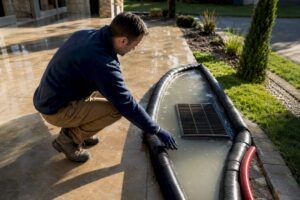
Two spots get missed constantly: dispenser skirts (the base panels around each pump, where fuel pools unnoticed) and drain inlets near the pad edges. Both need direct attention, because contaminants trapped there keep leaching onto clean surfaces after every wash.
Why Does Professional Pressure Washing Matter for Gas Station Safety?
Oil and fuel residue on concrete is not just unsightly. It is a documented slip hazard, and gas stations see steady pedestrian traffic moving between vehicles, pumps, and the storefront on surfaces that are already exposed to rain, ice, and spilled fluids.
Untreated petroleum residue also breaks down concrete sealants faster than plain weather exposure, which means resurfacing bills arrive sooner than they should. The same residue corrodes pump housings and canopy hardware if it sits for months instead of weeks.
The compliance signal to watch: Regulators treat washwater management, not spray pressure, as the deciding factor in whether a cleaning contractor exposes a property owner to fines. A contractor who captures and treats runoff protects you; one who doesn’t leaves the liability with you.
Beyond safety and equipment life, a clean forecourt shapes buying decisions. Drivers associate grimy pumps and stained concrete with poor maintenance overall, and that impression follows them inside to the register. Regular pressure washing improves both safety and curb appeal, which is a return most managers underestimate until they compare foot traffic before and after a deep clean.
- Reduced slip-and-fall exposure on high-traffic concrete.
- Slower equipment and sealant degradation.
- Measurable improvement in customer perception and repeat visits.
What Wastewater Rules Apply to Gas Station Cleaning?
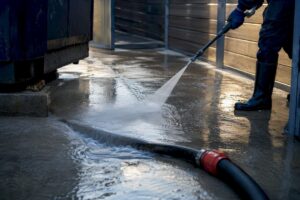
This is the part where most in-house crews and unlicensed vendors get it wrong, and it is the single biggest compliance risk on any commercial cleaning site. Washwater from a fuel station carries oil, grease, detergents, and sometimes heavy metals. Federal guidance is explicit: that runoff cannot go into a storm drain or surface water. It has to be collected and either treated on-site or discharged to an approved sanitary sewer with the sewer authority’s sign-off.
Contractors handle this a few different ways, depending on the site and the local sewer authority’s rules:
- On-board recovery systems that vacuum washwater as it’s generated, common on mobile units.
- Sumps and oil/water separators built into a designated wash pad, which treat contaminants before discharge.
- Temporary containment, where washwater is held in tankers and hauled off-site when sewer discharge isn’t permitted.
Before signing any contract, request documentation: a wastewater recovery certificate, written BMPs, proof of crew training on spill response, and any sewer authority approvals the contractor holds for your municipality. Municipal guidance generally requires these controls before a wash pad or mobile unit can legally operate at a fuel station.
Pro Tip: Ask for the recovery certificate before the quote, not after the job. A contractor who hesitates to produce one is telling you something about how they actually run their crews.
What Cleaning Process Should a Gas Station Contractor Follow?
The sequence matters as much as the equipment. A contractor who skips straight to high pressure without a dry-first step is pushing concentrated petroleum contaminants toward the nearest drain, which is exactly what fueling-area best practices warn against.
- Dry cleanup first. Absorbents soak up loose oil and fuel before any water touches the surface, cutting the volume of contaminated washwater dramatically.
- Contain the work area. Berms, mats, or portable containment keep runoff from spreading toward drains during the wash.
- Apply biodegradable, phosphate-free degreasers. These break down petroleum stains without adding another pollutant to the washwater stream.
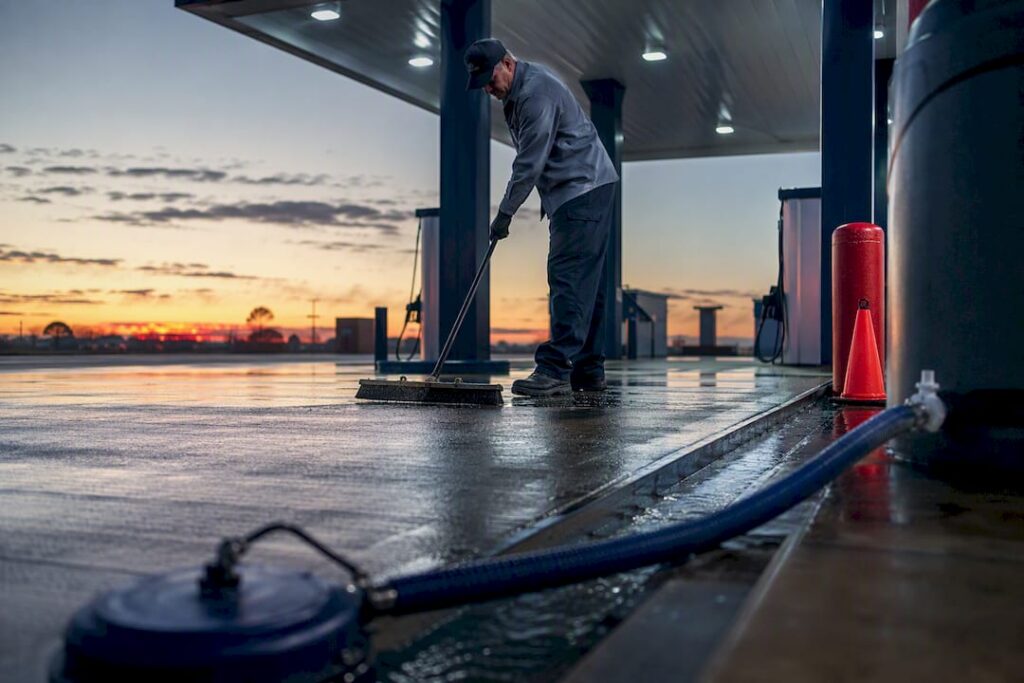
- Recover and treat washwater. Vacuum recovery or a sump-and-separator system pulls contaminated water off the surface as it’s generated.
- Final rinse and inspection. A clean-water rinse checks for residue, followed by a walk-through of dispenser skirts and joints.
For heavy petroleum staining on pump islands, hot-water units cut through grease faster than cold water alone, though cold water with the right degreaser handles lighter buildup fine. Storefronts, signage, and canopy fascia call for soft-wash technique rather than high pressure, since aggressive spray can strip paint or damage vinyl graphics. A credible quote lists the recovery equipment by name, whether that’s a vacuum boom, a mobile separator, or a tanker for off-site disposal.
How Often Should Gas Stations Schedule Pressure Washing?
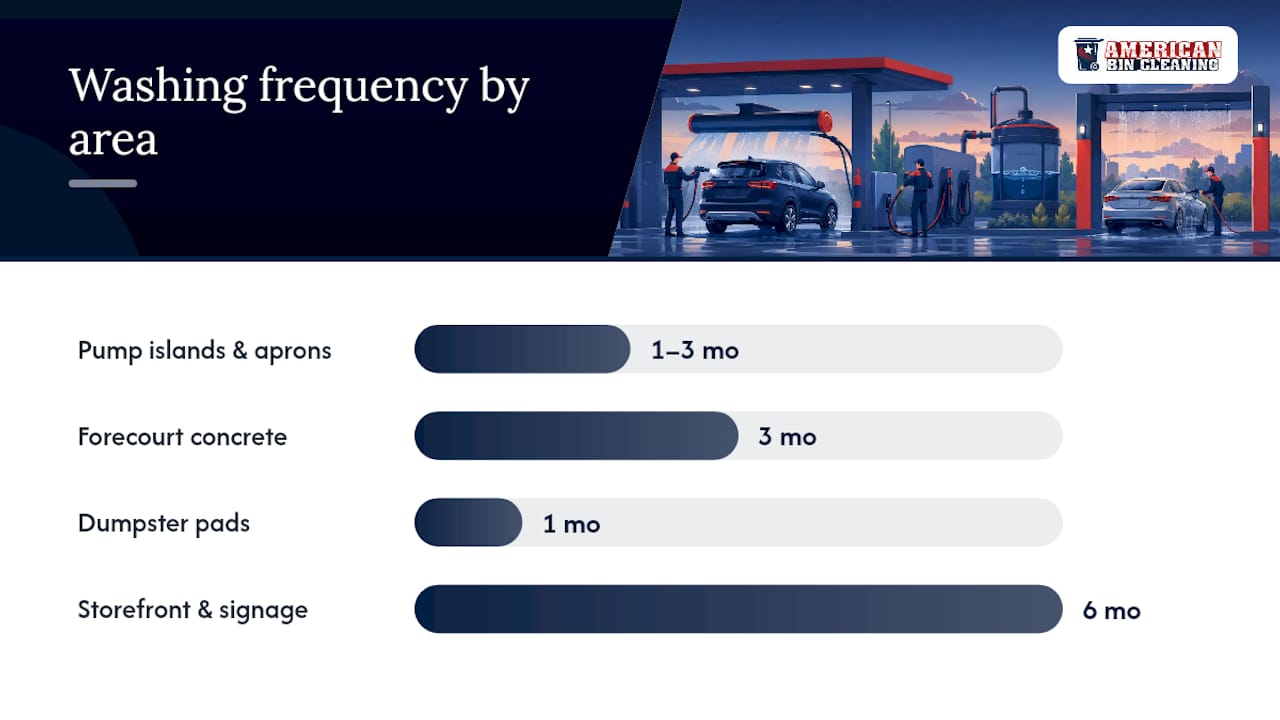
Frequency depends on traffic volume more than anything else. Pump islands and aprons see the heaviest contamination and generally need attention monthly to quarterly. Forecourt concrete overall holds up fine on a quarterly cycle. Dumpster pads, because of grease and odor buildup, do best monthly. Storefront exteriors and signage can usually stretch to twice a year.
Most contractors schedule the actual wash after hours or during lowest-traffic windows to avoid closing lanes during peak fill-ups, and that convenience typically carries a modest premium. Multi-site operators can often negotiate that premium down by locking in a seasonal or annual contract instead of booking one-off visits.
- Cost drivers to expect on a quote: traffic volume, stain severity, hot-water vs. cold-water equipment, wastewater capture requirements, and site layout or traffic control needs.
- Multi-site contracts typically lower the per-site rate through centralized scheduling and services.
Pro Tip: If you manage more than one location, ask for a single point of contact who schedules across all sites. It’s the fastest way to cut administrative back-and-forth out of a recurring contract.
How Do You Vet a Gas Station Pressure Washing Contractor?
Run through this before you sign anything:
- Confirm insurance coverage, including general liability and pollution liability specific to washwater discharge.
- Ask how washwater is captured and disposed of, and request the recovery certificate in writing.
- Check for documented BMPs and crew training records on spill response and containment procedures.
- Request references from other fuel station or commercial site clients, not just residential jobs.
- Get a written schedule and pricing structure, including after-hours availability and lane-closure logistics.
Red flags show up fast if you ask the right questions. A contractor who plans to hose runoff toward a storm drain, can’t produce insurance documents on request, or has no fuel-station references on hand is not one to trust with a compliance-sensitive job.
Why American Bin Cleaning Fits the Compliance Standard
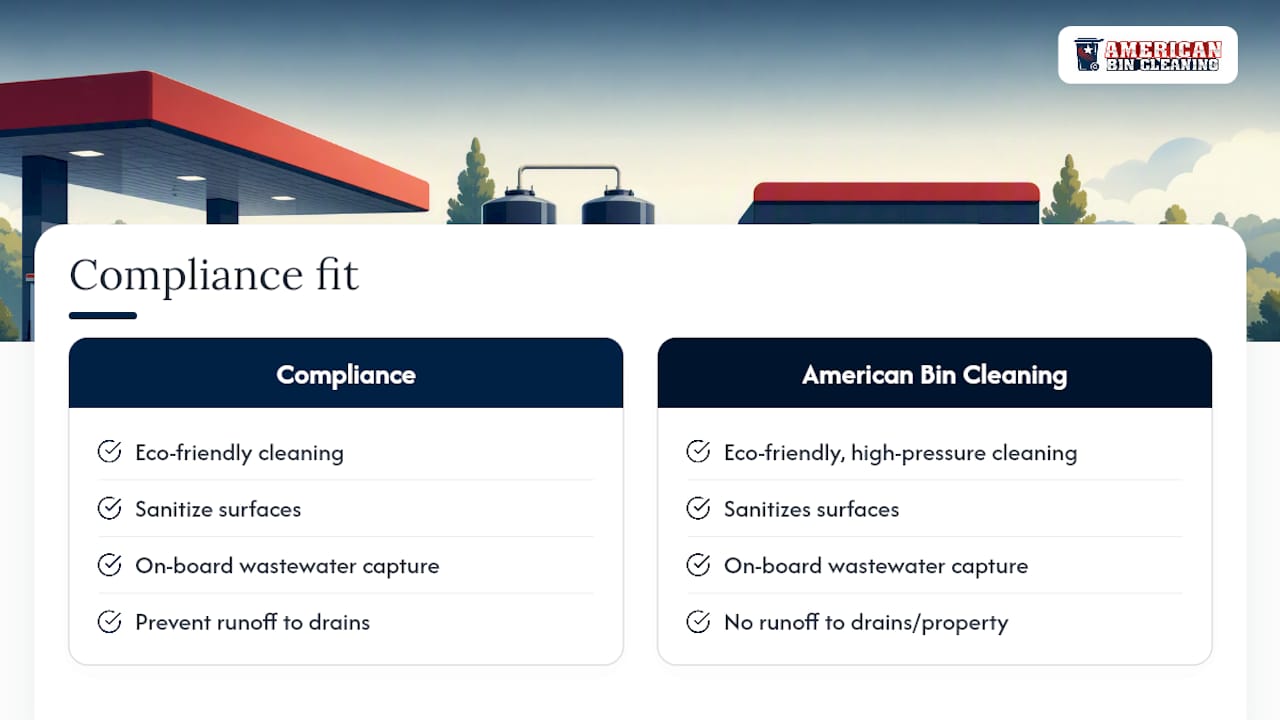
Family owned since 1989, American Bin Cleaning built its process around exactly the standard this article lays out: eco-friendly, high-pressure cleaning that sanitizes surfaces while capturing wastewater on-board, so nothing runs off into storm drains or the surrounding property. That on-board recycling system is the same capability the compliance checklist above demands from any contractor bidding on fuel-station work. Recurring service plans make scheduling around fuel-station traffic straightforward rather than an afterthought.
A Few Things I’d Insist on Before Signing Any Contract
If I were reviewing a scope of work for a fuel station, three things would be non-negotiable. First, a written dry-first step in the process, not just an assumption the crew knows to do it. Second, lane-by-lane cleaning with immediate containment of runoff, so nothing pools near a drain while the crew moves to the next section. Third, quarterly quick-sweeps scheduled between full deep cleans. That rhythm catches oil buildup before it hardens into a multi-hour job, and it costs far less than letting stains set for a year between contracts.
— Jim
Get a Site Assessment for Your Fuel Station
American Bin Cleaning brings the same eco-friendly, high-pressure process behind our bin cleaning work to fuel stations, parking lots, and storefronts, with washwater captured on-board instead of left to run off. That means you get a contractor built around the exact wastewater recovery standard covered above, not one bolting recovery equipment on as an afterthought.
Our commercial pressure washing services cover fuel islands, canopies, forecourts, and dumpster pads, with multi-site contracts available for operators managing more than one location. Service plans run monthly, bi-monthly, quarterly, or on-demand, so you can match the schedule to your traffic volume instead of overpaying for cleanings you don’t need. Request a site assessment to get a written proposal with pricing and after-hours availability for your location.
Sources
- Sector P: Transportation facilities — EPA guidance (Sector P)
- Current Best Practices in Maintaining Hydraulic Control at Fueling Facilities — EPA (NEPIS)
- Thurston County BMPs for vehicle/equipment washing