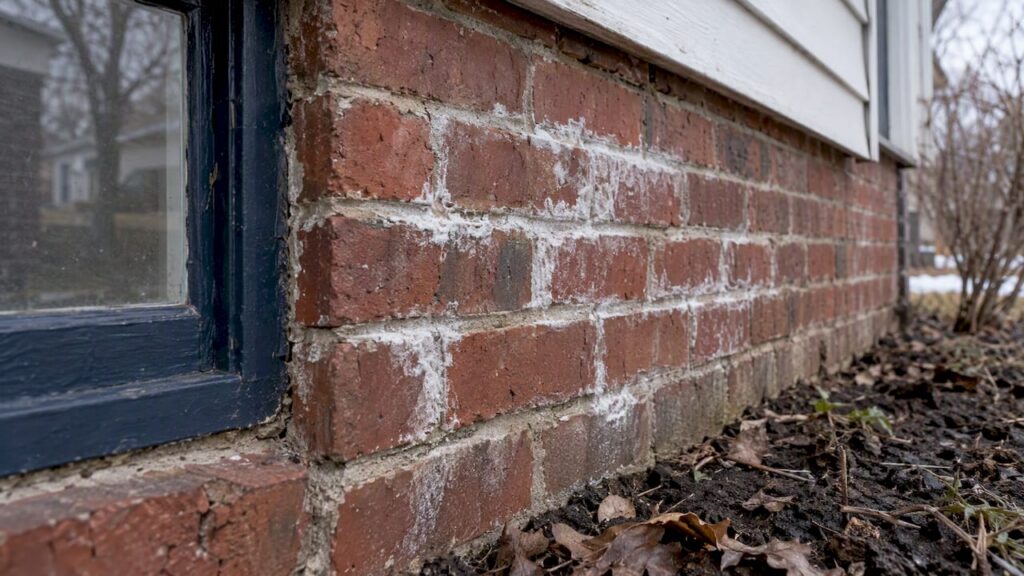
Efflorescence is a white, chalky deposit of soluble salts on brick, concrete, or stone, formed when water dissolves salts within the masonry and carries them to the surface, leaving them behind upon evaporation. The Concrete Masonry & Hardscapes Association identifies three necessary components for its formation: soluble compounds, moisture, and evaporation or hydrostatic pressure. While often cosmetic, persistent efflorescence can indicate underlying water intrusion issues in the structure, such as failed mortar joints or flashing. Controlling moisture is the most effective way to prevent its recurrence.
That white, chalky haze on your brick is efflorescence: soluble salts that water carried to the surface and left behind as it evaporated. In most cases it is cosmetic and you can brush or rinse it away. If it keeps coming back, or shows up on brick more than a year old, it is telling you water is getting into the wall, and that is the thing to fix.
What is Efflorescence and How to Address It?
- Efflorescence is a salt deposit, not mold or paint failure. Salts dissolve in water inside the masonry, travel to the surface and crystallize when the water dries.
- New brick often blooms during its first year as it dries out. That is normal and usually fades.
- Dry brushing and a gentle rinse are the safest first steps. Skip sandblasting, wire brushes and high-pressure blasting on brick.
- Acid cleaners are a last resort for stubborn deposits. Test a hidden spot, protect yourself and rinse right away.
- Deposits that return after cleaning point to moisture: failed mortar joints, flashing, gutters or grading. Fix the water, not just the white.
Table of Contents
- What efflorescence is and what causes it
- Is efflorescence on brick a problem?
- How to remove efflorescence from brick safely
- Removing efflorescence from concrete
- Why it keeps coming back, and how to stop it
- Our perspective: where cleaning helps and where it does not
- DIY or hire a pro?
- Ready for a cleaner exterior
- FAQ
- Sources
What efflorescence is and what causes it
Efflorescence is a crystalline deposit of soluble salts that appears when water is present in or on brick, concrete, stone and other porous materials. The Concrete Masonry & Hardscapes Association describes it as usually white, and says the salts come from masonry materials, trim, admixtures and groundwater.
Three things have to be present at once, according to the same source: soluble compounds, moisture to dissolve and move them, and evaporation or hydrostatic pressure to push the solution to the surface. Remove any one and the deposit does not form. Since you cannot easily remove salts that are baked into the materials of a finished wall, moisture is the one you can actually control.
The Brick Industry Association explains the mechanism simply: water dissolves salts, carries the solution through the pores of the masonry, and leaves the salts behind when the water evaporates. It lists the possible origins as mortar, grout, concrete, soil, groundwater, rainwater, cleaning chemicals, neighboring materials and the brick itself.
Why it shows up more in the Midwest
We work across northern Illinois and southern Wisconsin, and homeowners here tend to notice efflorescence in late winter and early spring. That fits the pattern the Brick Industry Association describes: deposits are often worse in cold weather. Wet snow against a foundation wall, a downspout that dumps beside a chimney, and a slow thaw all give salts the moisture and the slow evaporation they need.
Is efflorescence on brick a problem?
Usually not. The National Institutes of Health Office of Research Facilities technical bulletin on efflorescence says some efflorescence appears after construction, is not harmful, and may disappear naturally or wash off. A brick manufacturer’s technical bulletin from 2020 calls it generally cosmetic, with no normal effect on structural performance or durability.
The concern is what it signals. The NIH bulletin says persistent, repeated or excessive deposits may indicate excessive internal moisture, rising damp or other problems that should be investigated before they cause more serious damage. The same manufacturer bulletin warns that if the water sources are not stopped, older masonry may eventually suffer freeze-thaw damage and spalling, where the brick face flakes off.
New bloom or ongoing leak?
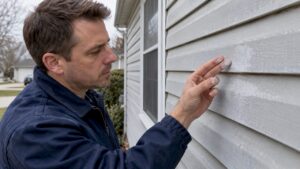
Age is the quickest sorting tool.
| What you see | Likely meaning | What to do |
|---|---|---|
| Even white haze on brick under a year old | The Brick Industry Association calls this new-building bloom, from normal post-construction drying | Wait, brush it off, and watch it |
| Deposits on brick more than a year old | The same source says this generally points to excessive water penetration or poor drainage | Look for the water source |
| Patches only below a window, chimney cap or roofline | A localized leak: flashing, sill, cap or joint | Inspect that spot after rain |
| Deposits low on the wall, with damp or peeling | Possible rising damp or grade problem | Check grading, drains and gutters |
| Flaking or crumbling brick face | Spalling may have begun | Call a masonry contractor |
If you see the last row, stop cleaning and get a mason out. Cleaning does not repair a damaged face.
How to remove efflorescence from brick safely
Start with the gentlest method and move up only if you need to. The NIH bulletin recommends gentle washing with water, mild detergent or an acidic solution that dissolves the salts without damaging the wall, and says to avoid sandblasting, wire brushes and other abrasive methods, especially on brick and soft stone.
Step 1: Dry brush
Pick a dry day. Use a stiff nylon-bristle brush, not a wire one, and loosen the powder while the wall is dry. Brushing dry keeps you from dissolving the salts and pulling them back into the pores. The manufacturer bulletin from General Shale recommends exactly this for homeowners: dry brushing followed by a light rinse with a garden hose.
Step 2: Rinse lightly
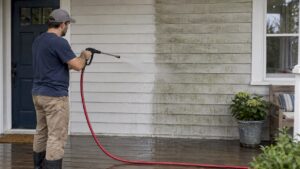
A garden hose is enough. The same bulletin says high-pressure washing is not recommended on brick for this job. That matches our own experience: forcing water into brick can push more moisture, and more dissolved salt, into a wall that already has too much.
Be prepared to repeat. The NIH bulletin cautions that washing can draw additional salts to the surface, so more than one round may be needed. A deposit that returns after a week of dry weather is usually the wall finishing its own drying, not a failure of your cleaning.
Step 3: Mild detergent for stuck deposits
If a light film remains, scrub with a soft brush and a mild detergent solution, then rinse thoroughly. Wet only the area you are working, and let the wall dry fully before judging the result.
Step 4: Acid only when nothing else works
Some deposits, including certain carbonate crusts, do not dissolve in plain water. The U.S. Army Engineer Research and Development Center technical note allows dilute acid for water-insoluble salts, with firm conditions:
- Test first on an inconspicuous area.
- Apply only to small areas.
- Rinse immediately with clean water.
- Wear protective gloves, eye protection and other protective clothing.
Follow the label of whatever masonry cleaner you buy, and do not mix products. If the brick is painted, glazed, very old or soft, or the mortar is crumbling, do not experiment: a test patch can leave a permanent blotch. This is the point to hire someone who cleans masonry for a living.
Removing efflorescence from concrete
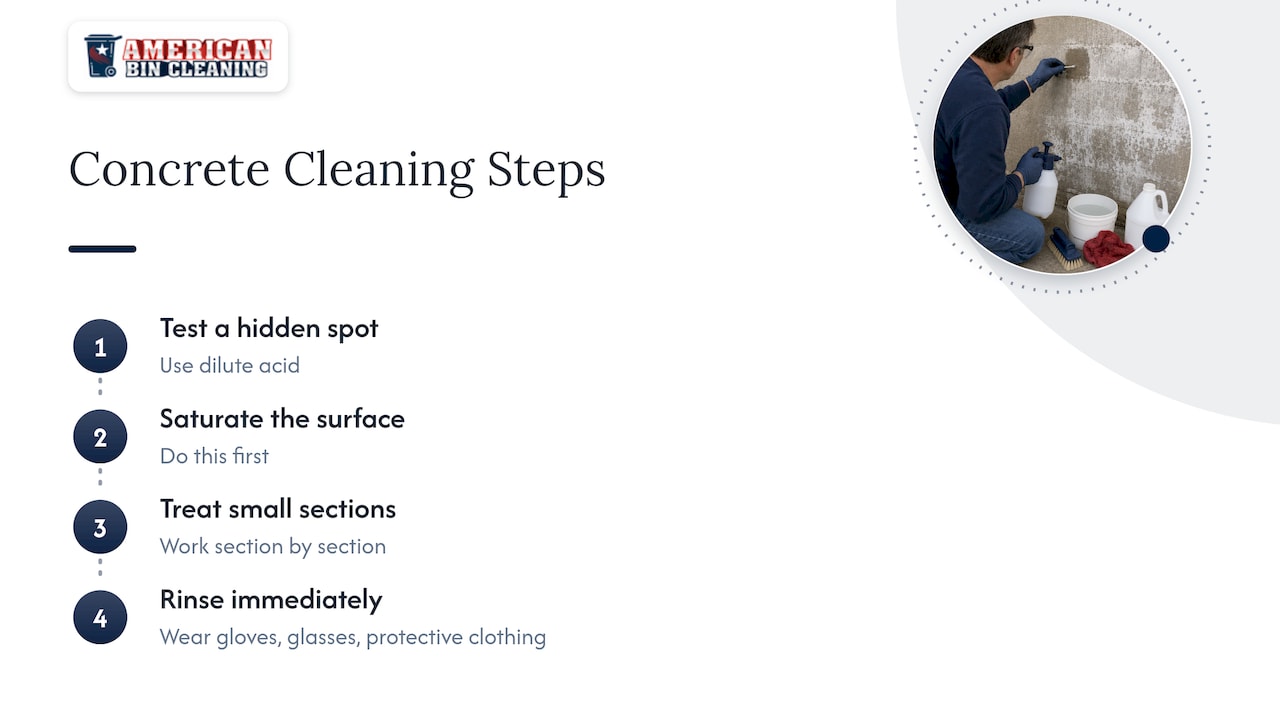
The same logic holds for concrete patios, steps and foundation walls, with one extra caution. For water-insoluble deposits, the ERDC note advises testing a dilute acid on a hidden spot, saturating the surface first, treating small sections and rinsing immediately, with gloves, glasses and protective clothing. Stronger solutions can etch concrete, expose the aggregate and change its color or texture, so more is not better.
Plain efflorescence on concrete often comes off with a stiff brush and water. If you are dealing with a pale haze on pavers rather than salt, you may be looking at something else, such as polymeric sand residue. Our guide to diagnosing and removing polymeric sand haze shows how to tell the two apart, and our page on pressure washing pavers covers safe pressure ranges for them. Pavers tolerate far more than aged brick does, which is why the advice differs.
Why it keeps coming back, and how to stop it
Cleaning treats the symptom. Prevention means cutting the water supply. The NIH bulletin recommends maintaining mortar joints, flashing and other water-entry details, grading the ground away from walls, and keeping drains, gutters and other water-conveyance systems in working order. The ERDC note adds moisture barriers, roof overhangs, relocating sprinklers, better drainage, and epoxy injection or chemical grouting at cracks or joints that keep producing efflorescence.
A practical walk-around, after the next hard rain:
- Gutters and downspouts. Look for overflow, loose seams and downspouts that end at the wall instead of several feet away.
- Sprinklers. Watch whether heads spray the brick. Move them.
- Grade. Soil, mulch and planting beds should slope away from the foundation, not toward it.
- Mortar joints. Probe for gaps, hairline cracks and joints that look sandy or recessed.
- Flashing and caps. Check above windows, at the chimney, at roof-wall intersections and under sills.
- Hose bibs. A leaking spigot can feed one patch of wall all summer.
For slabs and garage floors, moisture rising from below is the equivalent problem. A contractor checklist on moisture mitigation for concrete explains why testing a slab before coating it matters, since trapped moisture is what drives salts upward.
A warning about sealers
It is tempting to seal the wall and be done. The ERDC note cautions that water-repellent treatments can trap dissolved salts beneath the surface, and crystallization there can cause flaking or spalling. Fix leaks and drainage first, let the wall dry, and only then talk to a mason about whether any treatment fits your brick.
Our perspective: where cleaning helps and where it does not
We have cleaned homes, storefronts and trash areas across Chicagoland since 1989, and efflorescence is a question we hear every spring, usually phrased as “can you wash this white stuff off?” Our honest answer is: sometimes, and carefully.
Brick is not a driveway. Most of the damage we see from well-meaning cleaning comes from too much pressure and too much force on soft, aged brick and mortar. We would rather rinse gently and have you wait a week than strip the face off a wall that cannot be put back. If a wall has the pattern the research warns about, repeated deposits on older brick, we will tell you that washing is a stopgap and point you to the gutter, grade or joint that needs attention first.
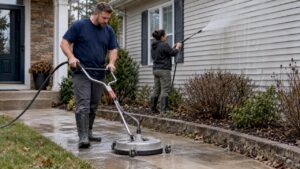
What we can do well is the cleaning around the problem. Once the water source is fixed, a controlled, low-impact wash removes the leftover film, algae, dirt and staining on siding, patios, walks and storefronts. Our process captures wastewater in an on-board recycling system, so salt-laden rinse water does not run off into your landscaping or the storm drain. See how often to pressure wash each surface of your house for the schedule we suggest, and the role of pressure washing in property upkeep for the bigger picture.
— Bill
DIY or hire a pro?
Do it yourself when:
- The deposit is light, dry and powdery.
- The brick is newer than a year and unpainted.
- You are comfortable with a brush and a hose and nothing more aggressive.
Bring in a professional when:
- The wall is tall, or needs ladders or lifts.
- The brick is old, soft, painted or glazed.
- You want to use acid, which carries real safety and surface risks.
- Deposits have returned more than once.
- The surrounding concrete, siding or walkways need cleaning at the same time.
If you are weighing the cost of hiring out wall cleaning, this breakdown of wall cleaning costs per square foot shows how interior wall work is priced, which is a useful contrast to exterior masonry work, where surface type and access drive the job.
Ready for a cleaner exterior
If your brick, patio or walkways need a careful wash after the moisture issue is sorted, our residential pressure washing services cover homes, decks, driveways and more across the Chicagoland area and into southern Wisconsin. You do not need to be home. For property managers, we also handle storefronts and commercial exteriors. Ask us about your specific wall before booking so we can tell you what is safe for your brick.
And while we are at your property: our curbside trash bin cleaning plans start with a monthly plan at $35 per 4 weeks, a quarterly plan at $45 per quarter, or a one-off on-demand cleaning at $75, so the bins at the curb stay as clean as the wall behind them.
FAQ
Is efflorescence on brick bad for the wall?
By itself, rarely. It is generally cosmetic and does not normally change how brick performs structurally. The risk is the moisture behind it: if the water source continues, older masonry can eventually suffer freeze-thaw damage and spalling.
Will efflorescence go away on its own?
Often, on new brick. Bloom on walls less than a year old commonly fades as the masonry finishes drying, and natural weathering can remove it. If it appears on older brick or keeps returning, expect to find and fix a water problem.
Can I pressure wash efflorescence off brick?
We advise against high pressure on brick. Manufacturer guidance recommends dry brushing and a light garden-hose rinse, and says high-pressure washing is not recommended. A professional using a gentle, controlled wash is a different matter, but only on sound brick and mortar.
What is the best efflorescence remover for brick?
The best first remover is a dry nylon brush, followed by water. Mild detergent comes next. Dilute acid products are for stubborn, water-insoluble deposits only, and must be tested on a hidden spot, used on small areas, rinsed immediately and handled with gloves and eye protection.
Should I seal brick after removing efflorescence?
Not until the leaks and drainage problems are corrected and the wall is dry. Government testing guidance warns that water-repellent treatments can trap salts under the surface and cause flaking or spalling, so ask a mason before you apply anything.
Sources
- Control and Removal of Efflorescence, Concrete Masonry & Hardscapes Association
- Efflorescence in Masonry Walls, NIH Office of Research Facilities Technical News Bulletin
- Efflorescence: Causes and Prevention, Brick Industry Association Technical Note 23A
- Efflorescence Information, General Shale Technical Bulletin
- Efflorescence technical note, U.S. Army Engineer Research and Development Center