
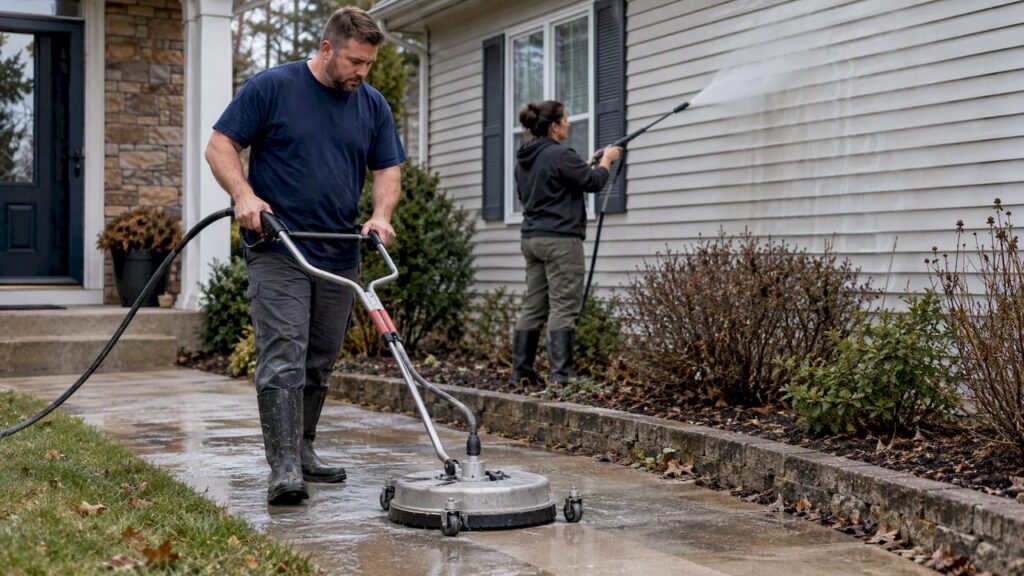
Soft washing cleans with low pressure and a cleaning solution that kills algae, mold and mildew. Pressure washing cleans with force, blasting dirt off hard surfaces. Use soft washing for roofs, vinyl siding, stucco and wood. Use pressure washing for concrete, brick and stone. Pick the wrong one and you can strip shingles, gouge a deck or leave the growth to return within months.
This guide explains the difference in plain terms, matches each method to the surfaces around a typical Chicagoland home, covers cost, and flags the part most homeowners miss: where the wash water goes.
TL;DR
- Soft washing runs under about 500 PSI and relies on cleaning chemistry. It is the right call for roofs, vinyl siding, stucco, painted surfaces and wood.
- Pressure washing uses roughly 2,000 to 4,000+ PSI of mechanical force. It suits concrete driveways, brick, masonry and similar durable surfaces.
- Neither method is “better” overall. The surface decides. Asphalt shingle makers warn against pressure washers on roofs altogether.
- Wash water is your responsibility too. Runoff into a storm drain can break local rules, so ask any contractor how they capture it.
Table of Contents
- What each method actually does
- Side-by-side comparison
- Matching the method to each part of your house
- What it costs
- The part most homeowners miss: where the water goes
- Our perspective
- How to choose a contractor
- Book with American Bin Cleaning
- FAQ
- Sources
What each method actually does
Pressure washing: force does the work
A pressure washer pushes a narrow stream of water at high speed. Typical working pressure is 2,000 to 4,000+ PSI. The water’s velocity knocks loose dirt, oil, tire marks and surface grime. Nozzle choice sets the spray angle: a wide fan is gentler, a tight zero-degree tip can cut into material.
That power is exactly why it works so well on a stained garage apron or a grimy patio. It is also why it causes damage on anything softer than stone.
Soft washing: chemistry does the work
Soft washing flips the approach. A cleaning solution, usually a mix of detergent, surfactant and a sanitizing agent, is applied at low pressure. It sits for a set dwell time, then gets rinsed off gently. One equipment maker’s guide describes soft wash systems as typically under 500 PSI, often close to garden hose pressure, with higher water flow than a pressure washer.
The solution does what force cannot: it kills the algae, moss and mildew at the root. Industry operators point out that blasting a surface may remove the visible stain but leaves the organic spores behind, so the green or black streaks come back sooner. Soft-wash results tend to last longer for that reason.

Where “power washing” fits
People also say power washing. The usual distinction is water temperature: a power washer heats the water, a pressure washer typically does not. Heated water helps with grease and oil, such as on a dumpster pad or a restaurant’s back lot. For a homeowner comparing quotes, treat the two terms as close cousins and ask the contractor for the PSI and whether chemicals are involved. Our own power washing vs pressure washing guide goes deeper on that split.
Side-by-side comparison
| Soft washing | Pressure washing | |
|---|---|---|
| Pressure | Under about 500 PSI | About 2,000 to 4,000+ PSI |
| What cleans | Detergent and sanitizing solution, low-pressure rinse | Water velocity |
| Kills growth at the root | Yes, that is its purpose | Not reliably; may leave spores |
| Risk to the surface | Low when done correctly | High on soft or layered materials |
| Best for | Roofs, vinyl siding, stucco, painted wood, decks | Concrete, brick, stone, masonry |
| Typical problem it solves | Algae streaks, mold, mildew, green film | Oil, ground-in dirt, tire marks, rust runoff |
| Main danger if misused | Plant damage or runoff if solution is not contained | Gouged wood, torn siding, water forced behind cladding, stripped shingles |
Matching the method to each part of your house
Roof
Soft wash only. The Asphalt Roofing Manufacturers Association states plainly that you should not use a power washer or a brush on the roof to remove algae, because high-pressure systems are likely to damage asphalt roofing. The granules on a shingle protect it from sun and weather. Strip them and you shorten the roof’s life and may jeopardize the warranty.

ARMA’s own guidance for lightening algae is a 50:50 mix of laundry-strength chlorine bleach and water, applied with a sprayer and left to dwell for 15 to 20 minutes, then rinsed. That is essentially the soft wash method. Roof work involves ladders, slopes and chemicals around landscaping, so it is a job for a trained crew rather than a weekend project.
Those dark streaks you see on Lake County rooftops are typically algae, not dirt, which is why scrubbing or blasting does not fix them.
Vinyl siding
Soft wash, or a very gentle low-pressure rinse with detergent. High pressure can crack panels and push water up behind the laps, where it feeds mold inside the wall. Manufacturer warranties often exclude pressure damage. We cover the details in our piece on pressure washing vinyl siding without voiding your warranty.
Stucco
Stucco is porous and can crack or erode under force. Keep it low pressure; see our guide to cleaning stucco safely under 500 PSI.
Wood decks and fences
Wood fibers tear under a tight nozzle, leaving fuzzy, scarred boards that hold water and grow more algae. Cleaning solution plus light pressure is the safer route. If you are weighing cleaning against sanding, read pressure washing a deck vs sanding it.
Concrete driveways, sidewalks and brick
This is pressure washing territory. Concrete tolerates the force, and oil, salt stains and embedded grime from Illinois winters need it. A surface cleaner attachment gives an even finish without the zebra stripes a bare wand leaves.
Pavers are the exception. Too much pressure blasts out the joint sand and lets the pavers shift. Keep to a moderate range, as laid out in our guide on pressure washing pavers at 500 to 1,500 PSI.
Mold: small spots versus real growth
A small patch of surface mold on a hard surface is a different problem from mold across siding or a shaded north wall. Our article on when pressure washing mold works draws that line. If growth is widespread, or you suspect it has gotten behind the siding, bring in a pro.
What it costs
Prices swing with region, house size, and access. Two published estimates give a useful ballpark:
- A guide updated for 2026 puts soft washing a 1,500 to 2,500 sq ft home exterior at $200 to $600, roof soft washing at $450 to $700, and two-story exteriors at $400 to $900.
- Angi reports that professional house washing runs about $0.10 to $0.50 per square foot, with stories and material driving the final number.
These are national figures, not our quotes. Chicagoland jobs can land above or below them.
A word on comparing bids. Estimators caution against judging quotes on square-foot price alone. A higher soft-wash quote often reflects proper dwell times, safety gear and containment to protect landscaping, while a bargain bid may skip those steps. A low price that ends in a replaced roof is not low.
The part most homeowners miss: where the water goes
Every wash produces dirty water. That water carries dirt, oil, bacteria and, in a soft wash, cleaning solution. In many places it cannot simply run down the driveway into the street.
Storm drains do not lead to a treatment plant. As Lake Zurich’s village site explains, what enters the storm sewer system is discharged into waterbodies used for swimming and fishing. Lake County municipalities work under a countywide stormwater program, and many U.S. towns have illicit discharge rules. Commercial managers in particular are often asked for proof of compliance, since the property owner is ultimately responsible for runoff.
And “eco-friendly” soap is not a free pass. University stormwater guidance notes that even biodegradable soap is harmful to the environment, which is why best practice is to capture wash water rather than let it go. A pressure wash also mobilizes whatever was already on the surface: oils, grit, bacteria. UNC’s guidelines lay out how wash water handling changes with and without soap.
Practical takeaway: before hiring anyone for either method, ask where the wastewater ends up. We go through the rules in our wastewater recovery guide and the containment basics in 5 containment steps for eco-friendly pressure washing.
Our perspective
We have been cleaning around Chicagoland since 1989, first and foremost trash bins, and that history shapes how we think about washing anything. A bin is a small version of the same problem: you are dealing with bacteria, grime and odor, and the dirty water has to go somewhere responsible.
Three things we tell customers:
- Start with the surface, not the equipment. The question is never “how strong is your washer?” It is “what is this material, and what is growing on it?” Strong is not the same as thorough.
- Capture the water. Our trucks use an on-board recycling system with a 17-stage filtration process, so wash water is not dumped or left to run off. That protects local waterways, and it protects you as the property owner.
- Ask before you approve. A good contractor can tell you the method, the pressure range and what happens to the water, in one conversation. If you get vague answers on a roof or siding job, keep looking.
Homeowners and major companies have trusted us for decades, and our approach has not changed: clean it properly, leave nothing behind.
— Bill
How to choose a contractor
Whether the job is a roof, a house wash or a driveway, check these before you book:
- Method for each surface. They should name soft wash for roofs and siding and pressure for concrete without being prompted.
- Pressure and chemicals. Ask for PSI ranges and what solutions they use near your plants and pets.
- Wastewater plan. Capture and recycling, not a rinse into the street.
- Warranty awareness. Roofing and siding makers set their own limits. A contractor who knows them protects your coverage.
- A written scope. Our home pressure washing service checklist and the guide to what home pressure washing includes show what a clear quote looks like.
Should you do it yourself?
Driveway and patio with a rented machine, possibly. Roof, siding and stucco, we would not. A single pass with the wrong nozzle can cause damage that costs far more than the cleaning. If you do try a DIY wash, our walkthrough on how to pressure wash a home exterior safely covers the safeguards.
Book with American Bin Cleaning
We clean driveways, homes, decks and storefronts across the northern Illinois and southern Wisconsin communities we serve, from Barrington and Lake Zurich to McHenry and Lake Geneva. You do not need to be home. See our residential pressure washing services, or for businesses, our commercial pressure washing services. Tell us what surface you have and what is growing on it, and we will recommend the right approach for it.
We also keep the bins at the curb clean. Our curbside plans are $35 per 4 weeks on the monthly plan, $45 per quarter on the quarterly plan, or $75 for a one-off on-demand visit. Details are on our trash bin cleaning page.
FAQ
Is soft wash better than pressure wash?
Not across the board. Soft washing is better for roofs, siding, stucco and wood, where it kills growth without damaging the material. Pressure washing is better for concrete, brick and stone, where force removes ground-in dirt. Many homes need both.
What do professionals use to soft wash a house?
A low-pressure pump or system with high water flow, plus a cleaning solution of detergent and a sanitizing agent, applied and left to dwell before a gentle rinse. For asphalt roofs, ARMA’s published method is a 50:50 mix of chlorine bleach and water. Pros also protect plants and manage runoff.
How much does it cost to soft wash a house?
National estimates put a 1,500 to 2,500 sq ft exterior at roughly $200 to $600, with two-story homes higher. Roofs usually run extra. Get a written quote based on your home’s size and condition.
Can I pressure wash my roof if the algae is bad?
No. Roofing manufacturers advise against power washers and brushes on asphalt shingles because they can damage the roofing. Use a low-pressure soft wash method applied by a trained crew.
Does the wash water really matter?
Yes. Runoff can carry pollutants into storm drains that reach local waterways, and property owners can be held responsible under local rules. Choose a contractor who captures and recycles it.
Sources
- Soft Wash vs Pressure Wash, Power Line Industries
- Pressure Washing vs Soft Washing, J.R. Acenstein
- Algae Discoloration of Roofs, ARMA
- Algae & Moss Prevention and Cleaning for Asphalt Roofing Systems, ARMA
- Pressure Washing cost estimate guide, Suparate
- How Much Does It Cost to Pressure Wash a House?, Angi
- Storm Water Management, Village of Lake Zurich
- NPDES Phase II, Lake County, IL
- Surface Cleaning pamphlet, MTSU Stormwater
- Power Washing Guidelines, UNC Environment, Health and Safety


