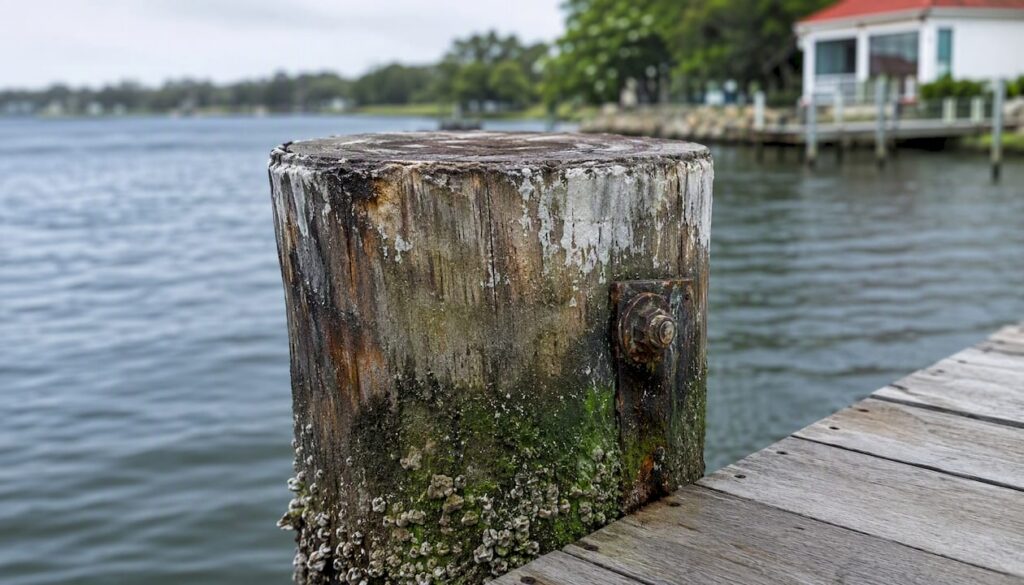
If you own a home on the water, expect eight recurring grime problems: salt crust (efflorescence), algae and biofilm, barnacles and other calcareous encrusters, marine borers, oil and boat residue, bird droppings with tannin stains, rust and corrosion, and slippery biofilms on walkways. Two things matter more than anything else right now: clear slip hazards off decks and docks immediately, and hold off on high-pressure cleaning until you know which surfaces can take it.
A study on salt deposition and exterior surfaces found that efflorescence on glass changes how heat moves through the pane, which can quietly increase your energy bills if window and door surfaces stay caked in salt for months. Separately, field guidance on barnacle and algae removal makes clear these two grime types need almost opposite treatment: barnacles require mechanical scraping because they cement onto surfaces, while algae responds to chemical soft-wash methods. Most coastal maintenance guidance settles on two professional cleanings a year, one in spring and one in fall, as the baseline for keeping any of this from becoming structural.
Waterfront grime isn’t one problem. It’s at least eight different ones, each with its own biology, its own damage pattern, and its own correct removal method. Treating them all the same way is how homeowners end up scraping through gel coat or blasting salt deeper into cedar grain.
A few first moves before anything else:
- Sweep or hose off slick walkways, dock boards, and steps the moment you notice a greenish sheen or dark slime.
- Skip the pressure washer on cedar, vinyl seams, window seals, or anything already showing wear until you’ve read which method fits which surface.
- If encrustation is thick or you’re seeing rust bloom at fasteners, book a professional assessment rather than guessing. A service like American Bin Cleaning uses eco-friendly, low-impact methods built for exactly this kind of job.
Key Takeaways
Waterfront homes face at least eight distinct grime types, each requiring a different removal method and material-specific handling to avoid costly damage.
| Point | Details |
|---|---|
| Identify the grime first | Salt crust, algae, barnacles, marine borers, oil residue, bird droppings, rust, and biofilm each need a different fix. |
| Treat slip hazards immediately | Clear slick biofilm off docks and steps before doing anything else. |
| Schedule twice-yearly professional cleans | Spring and fall cycles catch salt buildup and organic debris before they cause damage. |
| Match method to material | Soft wash wood and composite; use mechanical removal only on barnacles and hard encrusters. |
| Check fasteners seasonally | Rust bloom at fastener heads often signals hidden corrosion underneath. |
| Consider a professional partner | Abcbins offers eco-friendly, material-safe pressure washing with wastewater capture for waterfront properties. |
Table of Contents
- What Are the Common Grime Types on Waterfront Properties?
- Why Waterfront Grime Causes Real Damage, Not Just an Eyesore
- How Do You Remove Each Type of Grime Safely?
- Which Cleaning Method Fits Your Exterior Material?
- How Often Should Waterfront Homes Be Professionally Cleaned?
- What’s the Best Seasonal Prevention Checklist?
- Should You DIY Waterfront Cleaning or Call a Pro?
- An Editorial Perspective on Waterfront Maintenance
- A Cleaning Partner Built for Coastal and Waterfront Homes
- Sources
What Are the Common Grime Types on Waterfront Properties?
Each grime type has a distinct look, a distinct cause, and a distinct risk profile. Knowing which one you’re staring at saves you from using the wrong tool.
Salt crust (efflorescence) shows up as a white, chalky film on glass, metal railings, and masonry. It forms when saltwater spray evaporates and leaves mineral deposits behind, and it tends to build fastest on surfaces facing open water or prevailing wind.
Algae and biofilm appear as green, black, or brownish slick coatings, usually in shaded or consistently damp spots: north-facing siding, the underside of eaves, dock surfaces that rarely dry out. Marine growth documentation lists bioslime as one of the most common fouling issues on pilings specifically because those surfaces stay wet nearly around the clock.
Barnacles, mussels, and other calcareous encrusters cement themselves onto pilings, seawalls, and boat hulls with a permanent glue-like bond. Oysters do the same thing in brackish water. These look like hard, sharp-edged clusters, often gray or off-white, and they’re heavy enough to add real load to a piling over time.
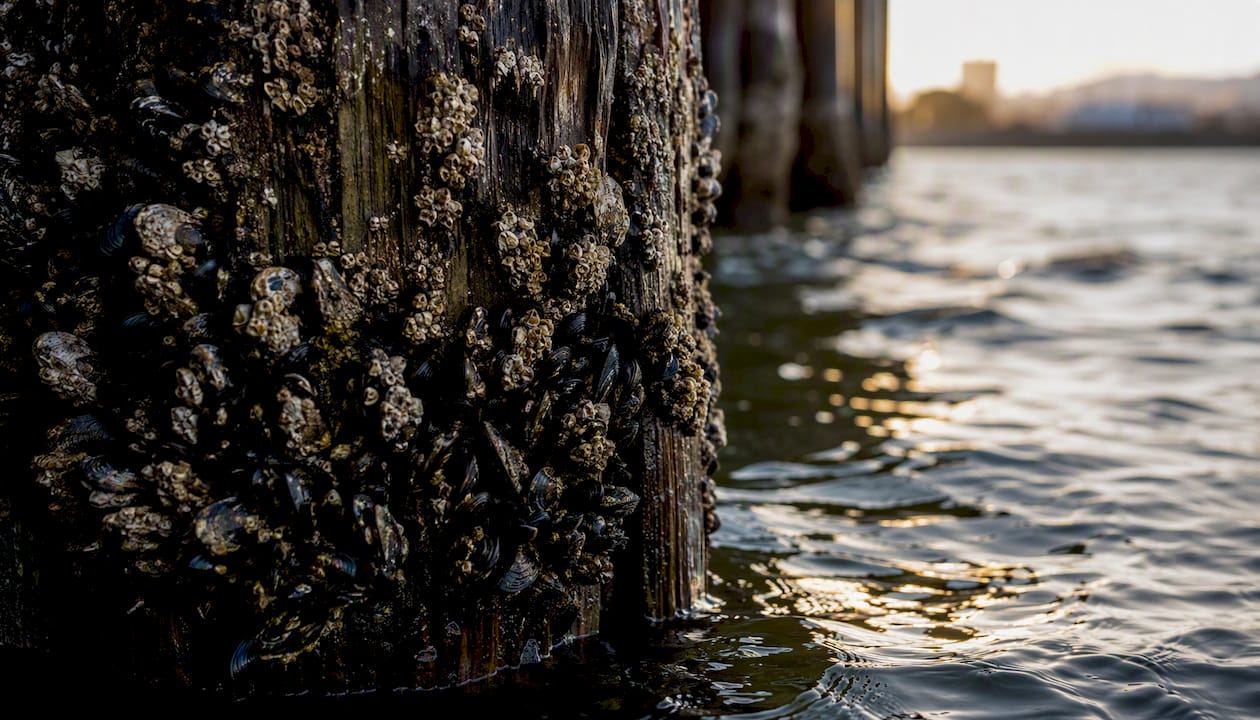
Marine borers, shipworms and gribbles among them, tunnel inside untreated wood below the waterline. You often can’t see the damage until a piling that looked solid suddenly feels soft or hollow when tapped.
Tube worms and hydroids form fuzzy or tube-like colonies on submerged structure, adding weight and drag but rarely structural danger on their own.
Oil, grease, and boat residue leave dark, sometimes rainbow-sheened stains on docks and seawalls near fuel or bilge discharge points.
Bird droppings and tannin stains show up as white or brown splatter on railings and roofs, with tannins adding rust-colored streaking wherever leaves and organic debris sit wet against wood or composite.
Rust and corrosion appear as orange or brown streaking around fasteners, hinges, and any exposed metal, almost always worse near saltwater exposure.
| Grime Type | Wood | Composite | Concrete/Masonry | Metal | Glass |
|---|---|---|---|---|---|
| Salt crust | Surface buildup | Minor buildup | Efflorescence, staining | Accelerates corrosion | Etching, thermal impact |
| Algae/biofilm | Discoloration, slip risk | Discoloration, slip risk | Slip risk on paths | Rare | Rare |
| Barnacles/encrusters | Structural load on pilings | Not typical | Not typical | Load on metal pilings | Not applicable |
| Marine borers | Internal decay | Not applicable | Not applicable | Not applicable | Not applicable |
| Oil/boat residue | Staining, absorption | Staining | Staining | Minor | Rare |
| Bird droppings/tannins | Staining, acid damage | Staining | Staining | Pitting risk | Spotting |
| Rust/corrosion | Fastener failure | Fastener staining | Rust streaking on masonry | Direct corrosion | Not applicable |
Why Waterfront Grime Causes Real Damage, Not Just an Eyesore
The visual problem is the least of it. Moisture retention under algae and biofilm accelerates wood decay, and the same damp conditions that grow algae also feed microbiologically influenced corrosion on fasteners and metal railings. Barnacle and mussel clusters add real weight and abrasive friction to pilings, while marine borers eat wood from the inside, so a piling can fail with almost no warning sign at the surface.
- Slip hazards from biofilm on docks and steps create real liability, especially with kids or older visitors around water.
- Rust bloom at fastener heads often signals the fastener itself is already weakening underneath.
- Untreated marine borer damage can mean replacing an entire piling instead of a simple repair.
- Persistent efflorescence on masonry usually points to deeper moisture intrusion, not just a surface stain.
Salt buildup on glass isn’t only cosmetic. Research on salt deposition and thermal performance found that efflorescence on exterior glazing alters convective heat transfer, meaning a salt-crusted window can quietly raise your heating and cooling costs. Add findings on coastal time-of-wetness showing that actual surface wetness on coastal exposures is substantially higher than standard models predict, and it’s clear why waterfront homes age faster than inland ones. Regional reporting on coastal exterior wear backs this up: salt spray, humidity, and wind-driven rain combine to accelerate paint chalking, metal pitting, and roof degradation significantly more than inland homes experience on similar materials.
How Do You Remove Each Type of Grime Safely?
Method matters as much as effort here. Use the wrong approach and you can etch glass, blow water into siding seams, or grind grit into gel coat.
- Algae and biofilm: soft-wash with a mild biodegradable cleaner at low pressure. Chemical treatment does the work; you shouldn’t need to scrub hard.
- Barnacles and oysters: these need mechanical scraping. Comparative guidance on removal methods confirms chemical cleaners alone rarely break the cement bond barnacles form.
- Marine borers: don’t attempt DIY removal. This calls for professional inspection and often preservative treatment or piling replacement.
- Oil and boat residue: use a low-pressure degreaser designed for marine surfaces, applied with contained runoff.
- Salt crust and tannin stains: a fresh-water rinse followed by mild detergent handles most buildup without abrasion.
- Rust and corrosion: treat with a rust-converting solution, then inspect and replace corroded fasteners rather than just cleaning around them.
Sequence matters when multiple problems overlap on the same structure. Here’s a practical order for a piling with both algae and barnacle growth:
- Rinse the surface with fresh water to loosen loose debris.
- Apply a soft-wash chemical treatment to kill algae and biofilm first.
- Let it dwell per the product’s instructions, then rinse again.
- Mechanically scrape barnacles and other calcareous growth once the slippery biofilm layer is gone.
- Inspect the exposed wood or metal underneath for hidden damage.
- Rinse thoroughly, containing runoff so nothing uncontrolled drains back into the water.
Soft-wash guidance for bay-front homes makes a strong case against defaulting to high pressure on cedar, vinyl seams, or window seals, since forced water can drive moisture into places it shouldn’t go.
Pro Tip: Always remove algae and biofilm before tackling barnacles on the same surface. The slime layer hides the true extent of encrustation underneath, and scraping through it first just regrinds grime into the surface instead of lifting it off.
Whatever method you choose, avoid letting runoff drain uncontained into the water. Use biodegradable cleaners near shorelines, keep chemical treatments away from nearby plantings, and never let wash water run toward a septic field.
Which Cleaning Method Fits Your Exterior Material?
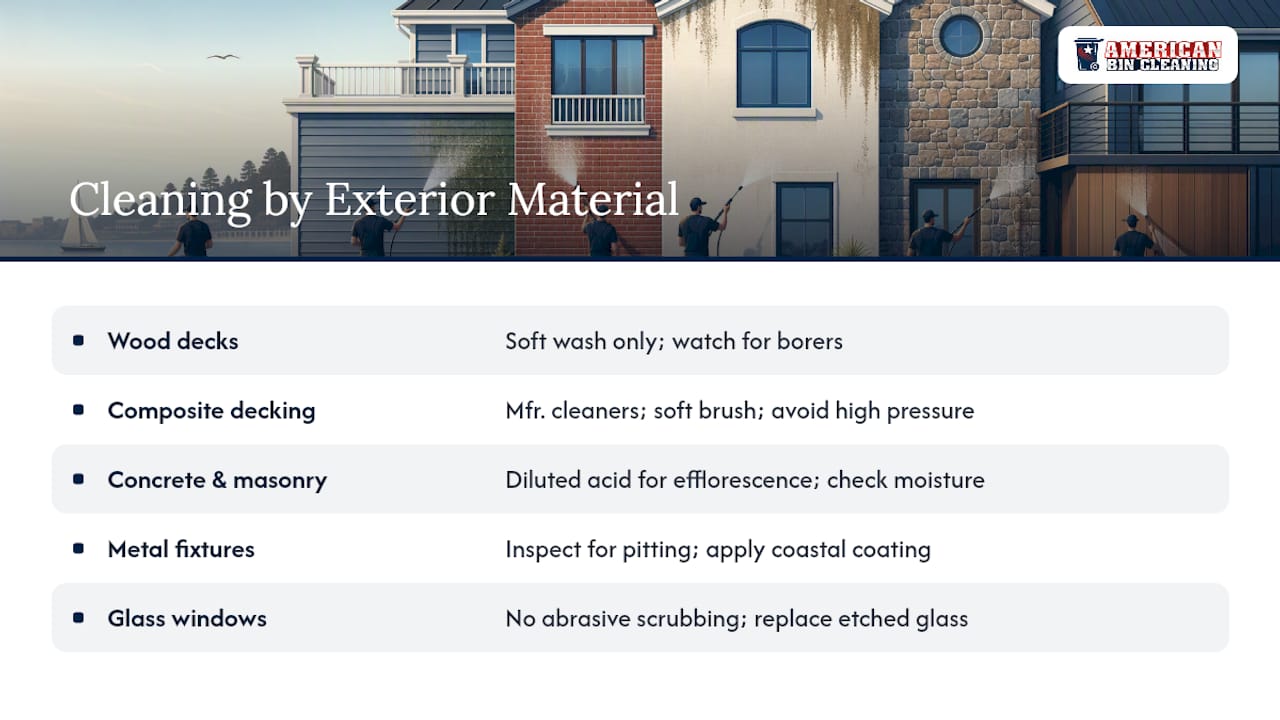
Wood decks and pilings should stick to soft washing only. Watch for hollow-sounding spots that suggest marine borer activity in untreated wood, and when replacing fasteners, use stainless steel or hot-dipped galvanized hardware rated for saltwater exposure.
Composite decking handles moderate cleaning better than wood but still shouldn’t see high pressure. Use manufacturer-approved cleaners and a soft brush; aggressive pressure can strip the surface finish and dull the color over a few seasons.
Concrete and masonry need targeted efflorescence removal, usually a diluted acidic cleaner made for the purpose. If the white crust keeps returning within weeks of cleaning, that’s often a sign of ongoing moisture migration through the material rather than just surface salt.
Metal railings, fasteners, and fixtures need regular inspection for pitting alongside cleaning. A protective coating formulated for coastal exposure extends the interval between rust treatments considerably.
Glass and sealed window units should never see abrasive scrubbing. The etching risk from salt crust is real, and once glass is etched, cleaning won’t reverse it. In some cases, the thermal performance research on salt deposition suggests badly etched glass is worth replacing sooner rather than later, since the efficiency loss compounds year after year.
How Often Should Waterfront Homes Be Professionally Cleaned?
Twice a year is the baseline: one cleaning in spring to strip off winter salt and biofilm buildup, and one in fall to clear organic debris before freezing weather sets in. This isn’t arbitrary. Spring removes what accumulated over winter storms, and fall prevents leaves, pollen, and tannin-producing debris from sitting wet against your surfaces all winter.
A thorough professional visit typically covers:
- Soft washing of siding, decking, and railings.
- Targeted mechanical removal of barnacles or calcareous buildup on docks and pilings.
- A dedicated rinse of glass and metal surfaces to remove salt crust.
- A fastener and hardware check for early rust or loosening.
- Wastewater capture so nothing uncontained drains toward the shoreline.
Before booking, confirm the crew covers each of those five items, plus how they handle wastewater and whether they’ve worked on materials like cedar or composite before.
| Frequency | Typical Outcome | Common Cost Driver |
|---|---|---|
| Twice yearly (spring/fall) | Prevents heavy buildup, catches issues early | Standard access and moderate encrustation |
| Quarterly | Best for heavy fouling zones or shaded areas | More frequent scheduling, less mechanical work per visit |
| Reactive/on-demand only | Higher risk of structural damage before it’s caught | Extensive mechanical removal, possible repair costs |
Cost typically hinges on access difficulty, how much mechanical scraping is needed for encrusters, whether any fastener or structural repair comes up during the visit, and how sensitive the materials are. A dock with heavy barnacle growth costs more to service than one with light algae film, simply because scraping takes longer than a soft-wash pass.
What’s the Best Seasonal Prevention Checklist?
Spring means clearing winter salt and debris, then soft washing exterior surfaces before summer humidity sets in. Mid-summer calls for checking shaded, north-facing spots where algae grows fastest even if the rest of the property looks clean. Early fall means clearing leaves and organic debris out of gutters and off decking before it sits wet all winter. Pre-winter means inspecting fasteners and flashings while you still have decent weather to fix anything loose.
Between those seasonal check-ins:
- Rinse salt off glass and railings after storms or high-wind days.
- Keep gutters clear so water doesn’t pool against wood or fascia.
- Trim back vegetation near the house to limit pollen and tannin runoff.
- Avoid fertilizer runoff into nearshore water, which feeds algae blooms that come right back onto your dock.
Print this list and run through it every three months. It takes fifteen minutes and catches problems while they’re still cheap to fix.
Should You DIY Waterfront Cleaning or Call a Pro?
Light algae on a flat, non-sensitive surface, a quick fresh-water rinse of railings, or spot-cleaning bird droppings are reasonable DIY jobs. Heavy barnacle encrustation, anything involving marine borers, structural inspection, or sensitive materials like cedar and composite are better left to a professional, particularly because runoff containment often requires equipment most homeowners don’t own.
Red flags that mean call a pro immediately:
- Timber that sounds hollow when tapped, suggesting internal borer damage.
- Dense, thick calcareous encrustation on pilings or seawalls.
- Efflorescence that keeps returning within weeks, hinting at ongoing moisture intrusion.
- Rapid regrowth of algae or biofilm within a month of cleaning.
- Rust bloom clustering specifically around fastener heads.
When you call, ask these questions before booking:
- How do you capture and handle wastewater from the job?
- Have you worked on waterfront materials like cedar, composite, or coastal masonry before?
- Are you insured for work near water and on docks or seawalls?
- Can you provide local references from other waterfront clients?
Compare quotes on more than price. A crew that skips wastewater containment might be cheaper, but it’s shifting environmental cost onto the shoreline you’re trying to protect.
An Editorial Perspective on Waterfront Maintenance
The biggest mistake I see waterfront homeowners make is treating cleaning as a once-a-year emergency instead of a scheduled routine. A cedar deck that gets a soft wash every spring and fall almost never needs sanding or refinishing. The same deck cleaned once every two or three years with a rented pressure washer usually shows etching, raised grain, or forced moisture in the seams within a season.
Fasteners are the other thing homeowners consistently underestimate. Rust at a fastener head looks minor until you realize the corrosion has been working its way down the shaft for months. Catching that early during a routine spring visit costs you a hardware swap. Catching it late costs you a structural repair.
American Bin Cleaning has been family-owned since 1989, and our eco-friendly pressure washing methods, including on-board wastewater capture, are built around the reality that waterfront properties need cleaning done without dumping chemicals or debris back into the water they sit on. Small, scheduled maintenance beats reactive repair almost every time, and the cost difference tends to be larger than homeowners expect.
A Cleaning Partner Built for Coastal and Waterfront Homes
Abcbins is the alternative to guessing which cleaner or pressure setting is safe for your dock, siding, or masonry. We use eco-friendly soft-wash and pressure-wash methods matched to the material in front of us, mechanical removal where barnacles or calcareous buildup demand it, and on-board wastewater capture so nothing runs off toward your shoreline.
We’ve been family-owned since 1989, and our crews are trained to know the difference between a surface that can handle real pressure and one, like cedar or a sealed window unit, that needs a gentler hand. Our recurring service plans line up naturally with the twice-yearly cleaning cadence that coastal maintenance guidance recommends, so you’re not stuck remembering to book every spring and fall on your own.
If you’re ready to get ahead of salt crust, algae, or that rust bloom you’ve been putting off, request a quote for residential pressure washing and we’ll walk your property before we touch a single surface.
Sources
- Salt deposition and thermal effects on exterior surfaces (ScienceDirect)
- Barnacles vs algae: Removal methods for piers
- How salt air and coastal weather accelerate exterior home wear – OCNJ Daily