
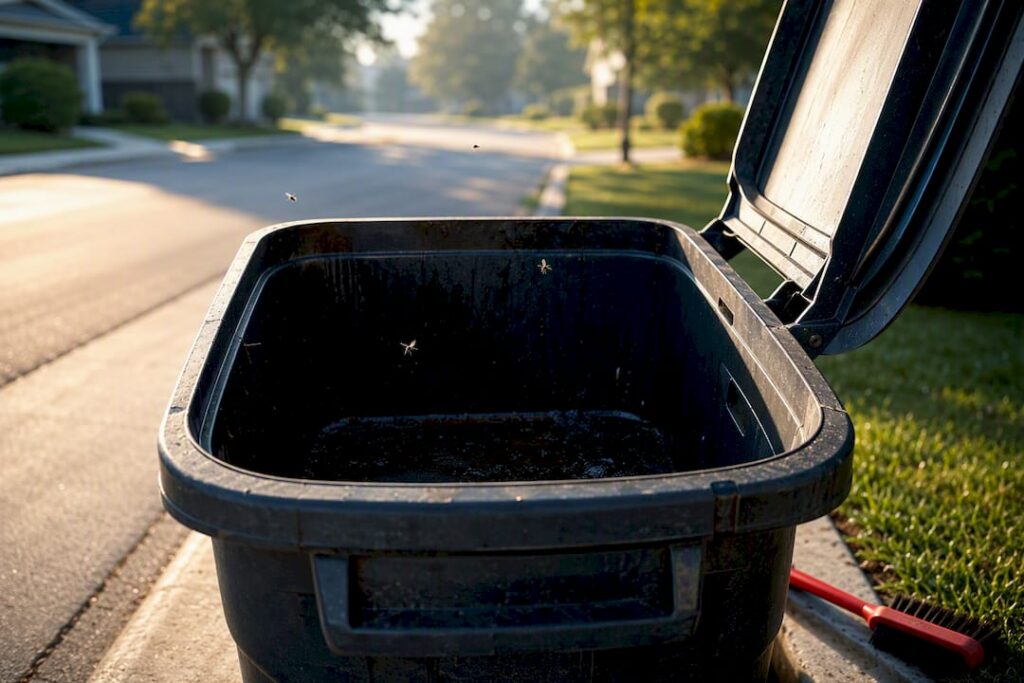
The fastest way to stop flies in a trash can is to remove whatever is feeding them, seal the lid, and kill the maggots already inside. Empty and double-bag odorous waste, scrub the bin walls where residue sits, and treat any larvae with boiling or soapy water. Set a trap or two for adults already loose. If flies keep coming back after all that, the breeding site probably isn’t your bin anymore, and it’s time for a professional cleaning or a pest inspection.
TL;DR:
- Flies can develop from eggs to adults in just about a week, especially in warm weather, making quick removal and cleaning essential.
- Sealing trash bags, removing rotting waste, and setting homemade traps with sugar water or beer effectively reduce adult fly populations fast.
- Boiling water directly onto maggots and thorough cleaning with soap and borax prevent recurring infestations and damage control.
- Maintaining a routine with tightly sealed lids, frequent trash disposal, and odor control prevents fly breeding over the long term.
- Professional bin cleaning services can eliminate residue and odor completely, especially for persistent or large-scale fly problems.
Table of Contents
- Why Do Flies Keep Showing Up in Trash Cans?
- What Kills Adult Flies in a Trash Can Fast?
- How to Get Rid of Maggots in a Garbage Can
- Building a Trash Can Maintenance Plan That Actually Prevents Flies
- When Should You Call a Professional for Fly Control?
- A Homeowner’s Priority Checklist for Fly Control
- How Professional Bin Cleaning Stops Flies for Good
- Where to Learn More About Fly Biology and Sanitation
- Sources
Why Do Flies Keep Showing Up in Trash Cans?
Flies don’t wander into your trash can by accident. Female flies actively hunt for moist, odorous surfaces to lay eggs, and a garbage bin is close to ideal: warm, dark, damp, and loaded with rotting protein. A few tiny grease specks on the inside wall or a puddle of meat juice at the bottom is enough to draw them in from yards away.
Once she lands, a single female can lay over 100 eggs in one batch, and she’ll lay several batches over her lifetime, according to UC IPM. Under warm conditions, those eggs can go from egg to flying adult in about a week. That’s the entire cycle: egg, then maggot, then pupa, then adult fly, compressed into little more than a week.
This is why a trash can that “seemed fine” three weeks ago can suddenly be swarming. Here’s the progression that plays out inside a neglected bin:
- Day 0 to 1: Odor and moisture attract egg-laying females to residue on the bin walls or bag.
- Day 1 to 3: Eggs hatch into maggots that feed on organic waste.
- Day 4 to 8: Larvae pupate, often near the bin’s edges or lid seam.
- Day 7 to 10: Adults emerge and start the cycle over, sometimes in the same bin.
Warmer weather speeds every stage along, which is why summer trash cans get infested faster than winter ones. It also means one missed pickup during a heat wave can undo weeks of otherwise clean habits.
What Kills Adult Flies in a Trash Can Fast?
Adult flies are the visible, buzzing symptom, but they’re not the root problem. Still, when you’ve got a cloud of them lifting off the lid every time you open it, you need something that works today, not just a long-term fix.
Start with the basics, in this order:
- Pull out anything visibly rotting or leaking. A single forgotten chicken bag can out-attract an entire clean bin.
- Seal the bag tightly and close the lid completely. A lid propped open by overstuffed trash is an open invitation.
- Set a homemade trap near the bin. A plastic bottle with a few inches of sugar water or beer, a splash of dish soap, and a paper funnel taped into the neck works well. Apple cider vinegar with a drop of dish soap in an open jar does the same job. Flies get in easily and can’t climb back out once the soap breaks the surface tension.
- Add a sticky trap or fly ribbon nearby, especially inside a garage or shed where bins live during winter. These catch stragglers without any chemicals.
For bigger outdoor problems, an electric bug zapper placed a few feet from the bin (never right next to it) helps thin out flying adults over a few days. A fly swatter or a handheld vacuum still works fine for one or two stubborn holdouts.
Skip aerosol insecticide sprays directed at the bin itself unless the infestation is severe and outdoors. Spraying inside a can does little against maggots and mostly just adds chemical residue to a surface that already needs cleaning. If you do use an outdoor insecticide, apply it around the base and lid seams, not into food waste, and never near a bin that sits close to a vegetable garden or a spot where pets or kids play.
Pro Tip: Rinse recyclables before they go in the bin. A sticky soda can or a yogurt cup with residue left inside is often the actual attractant, even when the trash bag itself looks clean.
Odor control matters just as much as trapping. A cup of baking soda in the bottom of the can absorbs smell without harming the bin. Activated charcoal pouches do the same job longer term. Citrus peels tossed in occasionally mask odor short term, though they’re not a substitute for actually cleaning the container.
How to Get Rid of Maggots in a Garbage Can
Maggots cluster where moisture and food scraps collect: the bottom seam of the bin, folds in the liner bag, and the underside of the lid where condensation drips down. If you see small, pale, wriggling larvae, you’re not looking at a future problem. You’re looking at flies that are already going to emerge within days.
Extension guidance from Arizona Extension points to boiling water as one of the most reliable homeowner treatments. Pour it carefully and directly onto visible maggots and the surfaces they’re clustered on. It kills larvae almost immediately on contact and helps loosen the grime they’re feeding on.
7 to 10 days. That’s how fast a fly egg becomes a flying adult in warm weather, per UC IPM. Every day you delay cleanup is a day closer to a brand-new generation taking flight from your own bin.
After the boiling water treatment, follow this cleaning sequence:
- Scrub the interior with hot, soapy water or a degreasing dish soap, focusing on the bottom and wall seams.
- Add a small amount of borax to the wash water for odor control, since IPM manuals list it as an effective, low-toxicity option for structural pest maintenance.
- Rinse thoroughly and let the bin air-dry upside down rather than sealing it back up wet.
- Dump the wash water down a drain or on gravel, never onto grass or soil near the house, where it can just create a new damp breeding spot outdoors.
Skipping the residue is the most common mistake homeowners make. UC IPM notes that even after the bag comes out, microscopic film left on plastic walls keeps attracting egg-laying females. The bag isn’t the bin.
Building a Trash Can Maintenance Plan That Actually Prevents Flies
A one-time cleanup buys you a few weeks at best. Keeping flies out long-term comes down to a routine, and the routine has five parts.

Lids and seals. A bin with a cracked, warped, or ill-fitting lid is basically an open bowl to a fly. If your municipal can has lost its seal, a bungee cord across the top or a heavy-duty elastic strap keeps it closed against wind and raccoons alike, and it stops the lid from popping open when the bag is slightly overstuffed.
Bagging habits. Double-bag meat, fish, or anything with liquid before it goes in the can. Drain liquids from cans and containers before tossing them, and give recyclables a quick rinse. None of this takes more than a few extra seconds, but it removes most of what actually attracts flies in the first place.
Emptying schedule. UC IPM recommends emptying trash at least weekly to break the life cycle before it completes. Bump that to twice a week during hot months or whenever you notice adult flies hanging around the bin.
Placement. Keep bins away from doors, windows, and patios, and position them upwind of entrances when you can. Texas A&M’s School IPM program recommends keeping dumpsters and bins away from building entrances and positioned upwind to reduce fly intrusion. Most residential yards can’t hit that distance, but even moving a can 10 feet farther from the back door reduces how often flies drift inside.
Ongoing odor control. Baking soda and charcoal sachets work well between cleanings. Commercial bin deodorizer tabs or sprays can help too, though they mask smell rather than eliminate the residue causing it.
Pro Tip: Keep a small bag of baking soda near your bin storage area and toss a scoop in right after each collection day, while the can is still empty. It’s the easiest habit to actually stick with because it takes ten seconds and you’re already standing there.
For more habit-level detail, see this rundown of trash can hygiene tips and additional ideas to reduce trash can smell between cleanings.
When Should You Call a Professional for Fly Control?
DIY sanitation solves most household fly problems within a week or two. A few signs point to something bigger than a dirty bin:
- Maggots keep reappearing within days of a thorough cleaning.
- Odor persists even after scrubbing and drying the can completely.
- Flies cluster around the bin area even when it’s empty and closed.
- You suspect a nearby breeding source you can’t reach, like a neighbor’s uncovered compost or a leaking sewer line.
Pest-control industry guidance is blunt about this: nothing controls fly populations better than sanitation, but sanitation only works if it reaches every surface where residue has built up. Encrusted grime in seams and lid tracks is tough to fully remove with a hose and a scrub brush in the driveway, especially in bins that haven’t been deep cleaned in a year or more.
A professional bin-cleaning service typically runs a high-pressure wash cycle through the entire interior, applies a sanitizing solution that targets bacteria and residue rather than just visible dirt, and neutralizes odor at the source instead of masking it. Reputable services also capture and recycle wastewater on board the truck, so nothing runs off into your yard or storm drain to create a second breeding spot.
Ask any provider you’re considering three things: how they handle wastewater, whether the service includes both washing and sanitizing (not just a rinse), and what scheduling options exist for repeat visits. If flies are recurring seasonally, a standing plan solves the problem before it starts each time. For truly large-scale infestations, or if you suspect breeding is happening off-site, a licensed pest control technician is the better call than a cleaning service alone.
A Homeowner’s Priority Checklist for Fly Control
Working with clients who call us after a fly problem has already gotten out of hand, the pattern is almost always the same: they treated the adults and ignored the source. Swatting flies or setting a trap feels productive, but it’s triage. The eggs and residue causing the problem are usually still sitting in the bin.

If I had 30 minutes to fix a fly problem, I’d spend it removing every scrap of exposed food waste, sealing the lid tight, and setting one trap. In the next 24 hours, I’d treat any visible maggots with boiling water, scrub the interior with soap, and settle on a firm disposal schedule instead of an “whenever it’s full” habit.
The part homeowners underestimate is maintenance cadence, not technique. A once-a-year deep clean isn’t sanitation. It’s damage control. Weekly emptying, a monthly wall wipe down, and keeping bins positioned away from doors will outperform any spray or trap you can buy, because you’re removing the reason flies show up instead of fighting them once they’ve arrived.
— Jim
How Professional Bin Cleaning Stops Flies for Good
If scrubbing a maggot-crusted trash can with a garden hose sounds like exactly the kind of Saturday you’d rather skip, that’s the gap a professional attic guano cleanup service exists to close. A curbside service handles the full cleaning cycle right at your curb: high-pressure washing, eco-friendly sanitizing that targets bacteria and residue on the bin walls, and odor neutralization that gets to the source instead of covering it up. You don’t need to be home, and wastewater is typically captured or recycled rather than dumped into your yard or storm drain.
Homeowners who deal with recurring fly problems, especially in warmer months, benefit most from a standing plan rather than a one-off wash. Monthly or bi-monthly service keeps residue from building back up between cleanings, which is exactly the window flies need to restart their life cycle. If you’re in the northern Illinois or southern Wisconsin area and ready to stop fighting the same infestation every few weeks, check out trash bin cleaning in Barrington or browse service plans to find a schedule that fits your household.
Where to Learn More About Fly Biology and Sanitation
For readers who want the deeper technical detail behind these steps, a few extension and industry sources cover the science thoroughly. UC IPM’s fly management page breaks down life cycle timing and sanitation priorities in detail. The Utah State University Extension IPM manual covers cleaning protocols and borax use for structural pest control. Arizona Extension’s fly management guide details boiling-water and soapy-water larvae treatments, and PCT Online offers a professional pest-control perspective on why sanitation outranks every other control method.
Sources
- Flies | UC IPM
- IPM manual: Flies (USU Extension)
- Controlling filth flies through sanitation | PCT Online
- Managing flies (Extension AZ)


