The Real Cost of DIY Trash Bin Cleaning
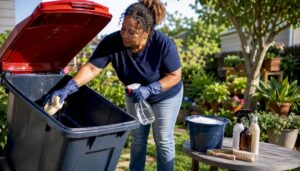
You’re standing in your driveway on a Saturday morning, staring at trash bins that smell like a dumpster behind a seafood restaurant in July. You think: “How hard can it be to clean these?”
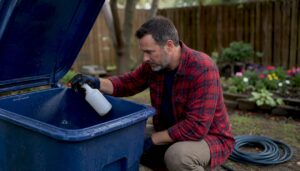
So you grab the garden hose, spray them out for a few minutes, maybe hit them with some dish soap, and call it done. The bins look slightly better. They still smell. And by next week, they’re just as bad as before.
Sound familiar?
Most homeowners try to clean their own trash bins at least once. Some stick with it for a while. But very few do it correctly, and almost nobody accounts for what it actually costs in time, money, and results that don’t really work.
Let’s break down what DIY garbage can cleaning really costs versus what you’re actually getting. The numbers might surprise you.
What You’re Actually Trying to Clean
Before we talk costs, let’s be clear about what you’re dealing with. This isn’t like washing your car. Your trash bins contain remnants of everything you’ve thrown away: rotting food, meat juices, spoiled dairy, dirty diapers, pet waste, and mystery liquids that have been sitting in plastic for weeks.
That combination creates a bacterial colony that would make a microbiologist nervous. Studies show the average trash bin contains more bacteria per square inch than a public toilet. We’re talking E. coli, salmonella, listeria, and other pathogens that can make people and pets sick.
When trash bags leak (and they always do), that contamination sticks to the bin walls and pools at the bottom. In summer, it becomes a breeding ground for flies and maggots. In winter, it freezes into a layer that’s nearly impossible to remove without serious heat and pressure.
Your garden hose, even with a spray nozzle, doesn’t touch this. You need hot water, real pressure, commercial-grade sanitizers, and proper technique. Without these, you’re basically just moving bacteria around and wasting your time.
The Time Cost: What Your Saturday Is Really Worth
Let’s start with time because it’s the cost most people underestimate.
If you’re going to do this right, here’s what’s actually involved:
Setup: 10-15 minutes
- Get your cleaning supplies together
- Move bins to where you can work on them
- Set up your cleaning area
- Put on gloves and protective gear
Cleaning each bin: 15-20 minutes
- Dump out remaining debris
- Rinse the interior
- Apply cleaner and let it sit
- Scrub all surfaces thoroughly
- Rinse again completely
- Apply sanitizer
- Final rinse and dry
Cleanup: 10-15 minutes
- Deal with the dirty water runoff
- Put away supplies
- Clean your tools
- Wash up
For two bins done properly, you’re looking at 60-75 minutes minimum. Most people have 2-3 bins. So plan on 90 minutes to 2 hours if you’re doing it right.
Now, what’s your time worth? If you make $30 an hour at work, that’s $45-60 in time value. If you make $50 an hour, that’s $75-100. And that’s assuming you’re efficient, know what you’re doing, and don’t waste time figuring things out.
Most people try this once, hate it, and then either:
- Stop doing it (bins get disgusting)
- Do a half-effort job that accomplishes nothing (bins stay disgusting)
- Keep doing it but resent every minute
None of these are great outcomes.
The Equipment and Supplies Cost
Let’s add up what you actually need to do this properly:
Initial equipment purchases:
- Pressure washer (if you don’t have one): $150-400
- Long-handled brush: $15-25
- Heavy-duty gloves: $10-15
- Safety glasses: $10-15
- Work boots or shoes you can get gross: $40-80
Per-cleaning supplies:
- Heavy-duty cleaner/degreaser: $8-15 per bottle
- Disinfectant or sanitizer: $10-20 per bottle
- Water usage: $2-5 per cleaning session
- Hot water (if you’re heating it): additional cost
If you’re starting from scratch, you’re into this for $250-500 before you clean your first bin. Sure, some of those costs are one-time, but you’re still investing significant money upfront.
And here’s the thing about pressure washers: most consumer-grade models don’t generate the heat or pressure needed to truly sanitize bins. You need 200+ degree water and 3,000+ PSI to kill bacteria. Most residential pressure washers deliver 1,300-2,000 PSI and don’t heat water at all.
So you’re buying equipment that costs hundreds of dollars but still can’t replicate professional results.
The Hidden Costs of Trash Bin Cleaning Nobody Talks About
Beyond time and supplies, DIY bin cleaning comes with costs that don’t show up on any receipt.
Water waste. When you’re working with low pressure, you compensate by using more water. A lot more. Professional systems use high-pressure, low-volume approaches that are actually more efficient. Your garden hose approach can waste 50-100 gallons per cleaning session, and you’re still not getting good results.
Improper disposal. Where’s all that dirty water going? If you’re washing bins in your driveway, it’s running into the street and down storm drains. That’s illegal in many municipalities because you’re sending bacteria, chemicals, and contaminants directly into local waterways.
Getting caught can result in fines ranging from $100-500 for first offenses. Even if you’re not caught, you’re creating an environmental problem and potentially a health hazard for your neighbors.
Damage to surfaces. Washing bins on your driveway means all that contaminated water sits on concrete. Over time, this can stain and discolor your driveway. The chemicals you’re using can also damage concrete sealant or cause pitting.
Then there’s the runoff spreading bacteria to areas where kids and pets play. Your driveway becomes contaminated. Your garage floor (if bins sit there between cleanings) becomes contaminated. You’re creating new problems while trying to solve the original one.
Physical strain. Trash bins are heavy, awkward, and require you to bend, lift, reach, and scrub. If you’re not in great shape, this takes a toll. Back strain, sore shoulders, and general exhaustion are common. For older homeowners or those with physical limitations, it’s not just hard. It can be risky.
Incomplete results. This is the biggest hidden cost. When DIY cleaning doesn’t actually work, your bins stay dirty, smelly, and bacteria-filled. That means:
- Continued odor problems
- Pest attraction (flies, maggots, raccoons, rats)
- Health risks to family and pets
- Embarrassment when neighbors notice
- Reduced curb appeal
- Potential HOA complaints
You spent time and money but didn’t solve the problem. That’s not saving money. That’s wasting it.
What Professional Service Actually Costs
Now let’s look at professional bin cleaning and what you get for the money.
Standard pricing for residential service runs:
- Monthly service: $35 per month
- Bi-monthly (every 8 weeks): $40 per service
- Quarterly (every 12 weeks): $45 per service
- One-time cleaning: $60
That’s for up to 2 bins. Additional bins are typically $10 each.
Here’s what that gets you:
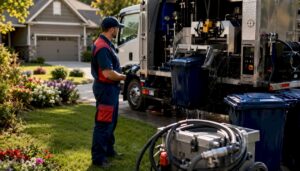
Professional equipment. Truck-mounted systems with:
- 200+ degree hot water that actually kills bacteria
- 3,000+ PSI pressure that removes stuck-on waste
- Commercial sanitizers and eco-friendly cleaning solutions
- Wastewater capture and proper disposal
Actual results. Your bins are genuinely sanitized, not just rinsed. Bacteria is killed, not relocated. Odors are eliminated, not masked. The difference is night and day compared to garden hose methods.
Zero effort on your part. Service happens on your trash day. You put your bins out like normal. They come back clean. You don’t touch anything, buy anything, or waste your Saturday.
Proper environmental compliance. Professionals capture wastewater and dispose of it legally. You’re not contributing to stormwater pollution or risking fines.
Consistency. This happens whether you feel like it or not. No skipping cleanings because you’re busy, tired, or it’s raining. Your bins stay clean year-round.
The Real Comparison
Let’s break down the actual annual cost of each approach for someone with 2 trash bins:
DIY (doing it quarterly, which most people can barely maintain):
- Time: 90 minutes × 4 cleanings = 6 hours
- Time value at $30/hour: $180
- Cleaning supplies: $40-60 per year
- Water and utilities: $20-30 per year
- Equipment depreciation/replacement: $30-50 per year
- Total: $270-320 per year
And that’s assuming:
- You already own a pressure washer
- You actually do it consistently
- You don’t factor in surface damage or fines
- You accept significantly inferior results
Professional service (quarterly):
- $45 × 4 cleanings = $180 per year
- Your time: 0 hours
- Your effort: None
- Equipment needed: None
- Supplies needed: None
- Results: Actually sanitized bins
- Total: $180 per year
The professional service costs less than DIY while delivering better results and requiring zero effort on your part.
If you go with bi-monthly service (which makes more sense in summer), it’s $240 per year. Still competitive with DIY costs, still way better results, still zero effort.
Monthly service at $420 per year is more expensive than DIY on paper. But consider what you’re comparing: 12 professional cleanings versus 4 DIY attempts that don’t really work. The value proposition is still strong.
When DIY Garbage Can Cleaning Might Make Sense
To be fair, there are scenarios where doing it yourself could work:
You genuinely enjoy this type of work. Some people find satisfaction in these tasks. If you’re one of them, have at it. Just do it correctly with proper equipment and technique.
You already own professional-grade equipment. If you have a commercial pressure washer with a heating element and know how to use it properly, your cost equation changes. Though you still have the time and effort factors.
You only need this occasionally. If you live alone, generate very little trash, and your bins rarely get dirty, maybe quarterly DIY makes sense. But honestly, most people in this situation still underestimate how dirty their bins actually are.
You have environmental concerns about service companies. Though reputable companies like American Bin Cleaning use eco-friendly products and proper wastewater disposal, so this concern is often misplaced.
For 95% of homeowners, though, professional service is the smarter choice. The cost is reasonable, the results are exponentially better, and your time is freed up for things you actually want to do.
The Bottom Line
DIY bin cleaning seems like a money-saving move until you add up the real costs: time, supplies, equipment, water, potential fines, surface damage, and the fact that your results still aren’t very good.
You’re spending $270-320 per year (including time value) to get mediocre results that don’t actually solve the problem. You’re wasting Saturdays on a gross, unpleasant chore that you’ll probably skip half the time anyway.
Professional service costs $180-420 per year depending on frequency. Your bins are actually sanitized, bacteria is eliminated, and you never think about it again.
The math isn’t even close. The quality difference makes it even less close.
Most people who try DIY bin cleaning do it once or twice, realize how terrible it is, and then either give up (leaving their bins gross) or wish they had just hired someone in the first place.
You can learn from their mistakes without repeating them. Your time, your health, your property, and frankly your Saturday mornings are worth more than what professional bin cleaning costs.
The question isn’t whether you can clean your own bins. The question is whether you should. And for most people, the answer is a clear no.
Ready to Stop Wasting Time and Money on DIY?
American Bin Cleaning has been providing professional, eco-friendly trash bin cleaning services to Chicagoland homeowners since 1989. We use commercial equipment and proven processes to deliver results you simply can’t achieve on your own.
Call 847-222-2467 to schedule your first cleaning. You’ll wonder why you ever considered doing this yourself.