
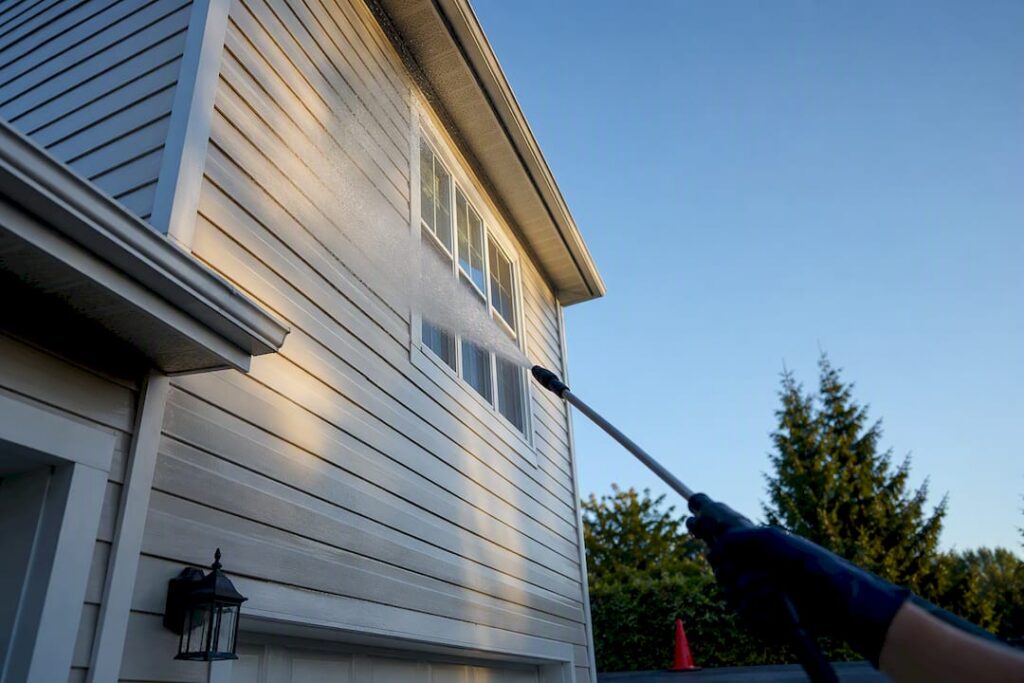
Expect to pay roughly $0.10 to $0.50 per square foot for professional siding cleaning, which puts most whole-house jobs between $200 and $700. Soft washing usually costs more per visit than pressure washing, but it often needs redoing less often. Most homeowners come out ahead hiring a pro unless the house is small, single-story, and the siding is in good shape.
TL;DR:
- Soft washing can be more cost-effective over two years because it prolongs mold and algae suppression compared to pressure washing alone.
- Costs vary significantly based on house size, siding material, accessibility, and complexity, with larger or multi-story homes costing substantially more.
- Hiring a professional with proper insurance and equipment reduces risks such as siding damage, mold growth, and personal injury, especially for complex or high-rise homes.
- Quotes should include detailed scope and measured square footage, and avoid verbal estimates, to prevent unexpected charges from hidden extras.
- Recurring cleaning every 12 to 24 months, combined with other exterior services, offers better long-term value than infrequent deep cleans.
Table of Contents
- Siding Cleaning Cost Breakdown by Square Foot and House Size
- Soft Wash vs Pressure Wash: Which Costs Less Over Time?
- What Actually Drives Your Siding Cleaning Quote Up or Down
- Sample Siding Cleaning Budgets You Can Copy
- DIY vs Hiring a Pro: The Real Cost Comparison
- How to Get an Accurate Siding Cleaning Quote
- Where This Guidance Comes From
- Budgeting Priorities for Long-Term Siding Care
- Book Siding and Pressure Washing With Abcbins
- Sources
Siding Cleaning Cost Breakdown by Square Foot and House Size
The per-square-foot math is where most homeowners get tripped up, mostly because contractors quote it three or four different ways. Homewyse puts the national average for power washing siding at about $0.45 to $0.56 per square foot, a bit higher than Angi’s broader $0.10 to $0.50 range. The gap usually comes down to region, siding condition, and whether the quote bundles in prep work like moving furniture or covering plants.
Run those numbers against real house sizes and the spread gets clearer:
- A 1,000 sq ft single-story home: a low to moderate price range.
Most quotes land near the median.
- An 1,800 sq ft two-story home: a wider price range depending on access and condition.
- A 2,500 sq ft two-story home with dormers or wraparound porches: higher pricing expected due to more complex access and trim work.
Quick numbers to know: Angi’s data shows typical whole-house jobs averaging $200 to $700, while Homewyse’s calculator lands slightly higher on a straight per-square-foot basis for power washing siding. Neither number accounts for a second story, which almost always adds cost.
Contractors price this work four main ways, and knowing which one you’re getting changes how you compare bids. Some quote a flat per-square-foot rate, which is the easiest to compare across companies. Others charge an hourly rate with a minimum, usually two or three hours, which tends to punish small jobs. A flat per-house price is common for straightforward one-story homes where the crew can eyeball the square footage. And almost every company enforces some kind of minimum charge, often $150 to $250, because driving a truck and rig to a job site costs money regardless of how small the house is.
Homewyse notes that contractors will apply minimum labor charges and hourly rates once a job involves complex access, like scaffolding for a three-story colonial. That’s the detail that turns a “$0.45 per square foot” quote into something twice that once you add the second story.

Soft Wash vs Pressure Wash: Which Costs Less Over Time?
Pressure washing uses high water pressure alone to blast dirt off a surface. Soft washing uses low pressure paired with a cleaning solution, usually a mix of water, bleach or a bleach alternative, and a surfactant, to kill mold and algae at the root rather than just knocking it loose. That difference in method is the single biggest driver of long-term cost, more than square footage.
Soft washing typically runs a bit higher per visit, but industry comparisons suggest it can come out cheaper over a 24-month cycle because the chemical treatment suppresses algae and mildew regrowth longer than a plain water blast does. Pressure washing without any treatment often needs a repeat clean within a year on shaded, humid-prone sides of the house.
- Pressure washing alone: lower upfront cost, faster regrowth of algae and mold, higher risk of forcing water behind panels on vinyl.
- Soft washing: moderate upfront cost, slower regrowth, generally gentler on siding seams and trim.
- Hybrid approach (soft wash on siding, pressure wash on hardscape): common on full-property jobs and usually priced as separate line items.
Manufacturer guidance backs the safety case for soft washing on most residential siding. CertainTeed recommends low-pressure, hose-based cleaning for vinyl and specifically warns that high pressure can force moisture behind panels, causing damage or discoloration. James Hardie gives similar guidance for fiber cement, recommending low pressure and soft bristle brushes rather than a pressure washer wand.
Pro Tip: If your home sits under tree cover or on the shaded north side of a lot, pay the extra for soft washing. The algae and mold that thrive in that shade come back fast after a plain pressure rinse, and a second cleaning within a year usually costs more than the soft wash premium would have.

What Actually Drives Your Siding Cleaning Quote Up or Down
A quote is never just square footage times a rate. Several factors swing the price by 20% to 50% in either direction, and understanding them helps you spot a lowball bid that’s missing something.
- Siding material and condition: heavy mildew, rust streaks from sprinklers, or years of built-up grime take longer and often need a stronger dilution than a routine annual clean.
- Height and access: a second or third story, steep rooflines, or landscaping that blocks ladder placement adds labor time and sometimes requires specialized equipment.
- Biological growth vs. surface dirt: algae and mold need chemical treatment time to work, while loose dirt and pollen wash off fast, so a “dirty” quote and a “moldy” quote aren’t the same job.
- Landscaping protection and water capture: covering delicate plants and containing runoff, especially near storm drains, adds setup time that a bargain quote might be skipping.
- Disposal and environmental controls: contractors who capture and properly dispose of wastewater instead of letting it run into the yard or street typically build that into the price.
Add-ons are where a “cheap” quote often turns expensive. Mildew-kill pretreatment can add $50 to $150. Caulking repairs around trim run $75 to $200 depending on how much has failed. Stain treatment for rust or tannin bleed from cedar shingles adds another $50 to $100. None of these are optional once a contractor spots the problem mid-job, so ask about them upfront.
Local labor rates matter too. BLS wage data shows home services labor costs vary significantly by metro area, and that difference shows up directly in contractor rates. A crew in a high-wage metro area will simply cost more per hour than one in a rural market, even for identical work.
Sample Siding Cleaning Budgets You Can Copy
These three budgets cover the range most homeowners fall into. Match your house to the closest one and adjust for your local market.
- Small home, 1,000 sq ft, single-story vinyl. Base wash: $150 to $250. Mildew pretreatment if needed: $50 to $75. Total range: roughly $150 to $325. This is close to the minimum-charge territory many contractors enforce regardless of square footage.
- Medium home, 1,800 to 2,000 sq ft, two-story vinyl or fiber cement. Base wash: $350 to $600. Second-story access surcharge: often folded into the base rate but sometimes billed separately at $50 to $100. Caulk touch-up if trim has gaps: $75 to $150. Total range: roughly $400 to $850.
- Large home, 2,500+ sq ft, two-story with dormers, stucco or brick accents. Base wash: $600 to $1,200. Extra time for detailed trim and multiple materials: $100 to $250. Stain or rust treatment: $50 to $150. Total range: roughly $700 to $1,600.
National averages put most single jobs between $200 and $700, but Homewyse’s per-square-foot data suggests homes on the larger end can push past that comfortably. Spring and fall bookings run cheapest since crews aren’t slammed with the summer rush; expect a modest premium, sometimes 10% to 15%, if you need a slot during peak season in June or July.
DIY vs Hiring a Pro: The Real Cost Comparison
Renting a consumer-grade pressure washer runs $50 to $100 for a weekend, plus $20 to $40 for cleaning solution, plus your entire Saturday. That sounds cheaper than a $400 professional quote until you account for the risk. Consumer Reports notes that consumer-grade equipment is generally less powerful and less controllable than what pros use, which raises both the odds of a bad result and the odds of damage.
- Stripped paint or damaged siding from too much pressure can cost $200 to $2,000 to repair, wiping out any DIY savings instantly.
- Water forced behind vinyl panels can lead to mold growth inside walls, a repair bill that dwarfs the original cleaning cost.
- Pressure washer injuries are a documented safety concern, particularly from kickback on ladders or wands catching on gutters.
Hiring a licensed, insured professional makes the most financial sense on two-story homes, houses with heavy mold or algae, or anywhere manufacturer warranties require documented low-pressure methods.
Pro Tip: Always ask for proof of insurance before booking. If a ladder slips and damages a window or gutter, an uninsured operator leaves you covering that repair out of pocket on top of the cleaning cost.
How to Get an Accurate Siding Cleaning Quote
A phone estimate based on “about how many square feet” is how homeowners end up with surprise charges. Get everything in writing before the crew shows up.
- Ask which method they’re using and why, soft wash versus pressure wash, and get the pressure PSI range they plan to use on your specific siding.
- Request an itemized scope: square footage actually measured (not guessed), cleaning solutions, prep steps, and how they handle water disposal or capture.
- Confirm insurance and ask for references, especially for two-story jobs or homes with delicate landscaping nearby.
- Compare the written estimate line by line, not just the bottom-line total, since two quotes at the same price can cover very different scopes.
Treat a verbal-only quote with no mention of pressure settings or water capture as a red flag. A fair written estimate names the method, the square footage, any pretreatment, and what happens to the wastewater.
Where This Guidance Comes From
The advice here is informed by daily experience running eco-friendly, high-pressure cleaning equipment on bins, driveways, decks, and building exteriors in the Chicagoland area. That day-to-day work with wastewater capture systems and pressure calibration is exactly what informs safe, low-damage siding cleaning advice. If you want eyes on your specific home before committing to a number, request a local estimate and get a scope built around your actual siding, not a generic average.
Budgeting Priorities for Long-Term Siding Care
Skip the once-a-decade deep clean mindset. Budget for recurring care every 12 to 24 months instead, and bundle it with other exterior jobs to save on mobilization costs.
— Jim
Book Siding and Pressure Washing With Abcbins
Homeowners can hire a single crew to handle exterior jobs for siding, driveways, and decks using eco-friendly, high-pressure equipment with wastewater recycling systems that prevent runoff, and often without needing to be home during service.
Beyond one-time siding cleaning, we offer residential pressure washing services on flexible plans, monthly, bi-monthly, quarterly, or on-demand, so algae and mildew never get the chance to build back up between visits. Bundling siding cleaning with driveway or deck washing can lower per-visit costs since the crew is already on-site. If you’re in the Barrington area, get a local estimate and find out what your specific home would run before you commit to anything.
Sources
Homewyse and Angi supplied the per-square-foot and per-job cost data. CertainTeed and James Hardie provided manufacturer cleaning guidance. BLS wage data explained regional labor cost variance.
- Cost to Power Wash Siding — Homewyse
- How Much Does It Cost to Pressure Wash a House? — Angi
- Occupational Employment and Wage Statistics — BLS


